









How One Scientist Changed Farming in the South
As American agriculture expanded southward from the Carolinas into what are now Georgia, Alabama, and Mississippi, farmers faced both opportunity and uncertainty. The region’s warm climate and fertile soils allowed for the cultivation of a variety of crops, including peanuts, sweet potatoes, and soybeans. However, growing these crops was only part of the challenge. Finding profitable markets and sustainable farming practices proved difficult for many producers.
The future of Southern agriculture would be dramatically influenced by one remarkable individual: George Washington Carver.
Agriculture’s Growing Pains in the South
During the late 19th and early 20th centuries, Southern agriculture relied heavily on cotton production. Years of continuous cotton cultivation depleted soil nutrients and left many farms vulnerable to declining yields and economic hardship.
As farmers searched for alternatives, crops such as peanuts, sweet potatoes, and soybeans began appearing across the region. While these crops showed promise, there was a significant problem: demand was limited, and many producers struggled to find profitable uses and markets for their harvests.
The South needed innovation—and George Washington Carver delivered it.
George Washington Carver’s Revolutionary Contributions
George Washington Carver, a scientist, educator, and agricultural innovator, dedicated much of his career to helping farmers improve their livelihoods through better agricultural practices.
Working at the Tuskegee Institute in Alabama, Carver conducted extensive research on alternative crops and practical farming methods. He became widely known for discovering and promoting new uses for peanuts and sweet potatoes, helping create market opportunities for crops that had previously been overlooked.
His work encouraged farmers to diversify their operations rather than depend solely on cotton production.
Finding New Uses for Peanuts and Sweet Potatoes
One of Carver’s most significant achievements was identifying numerous practical applications for peanuts and sweet potatoes.
His research led to the development of products ranging from food items and cooking ingredients to industrial and household applications. By demonstrating the versatility of these crops, Carver helped create greater demand and new economic opportunities for Southern farmers.
As a result, peanuts and sweet potatoes became more valuable commodities, giving producers additional income sources and reducing their dependence on a single crop.
Promoting Crop Rotation and Soil Health
Beyond developing new markets, Carver championed farming methods that improved long-term productivity.
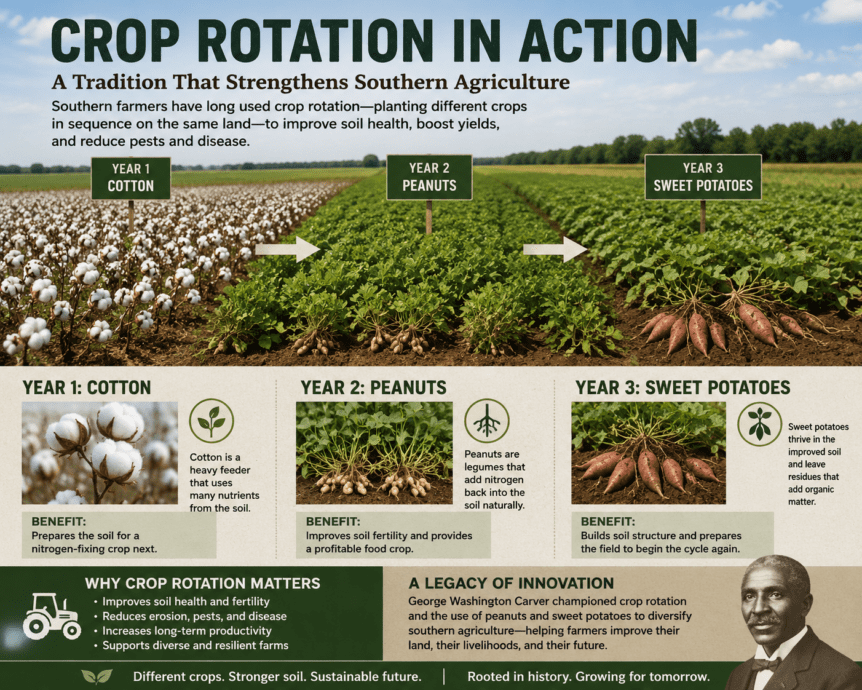
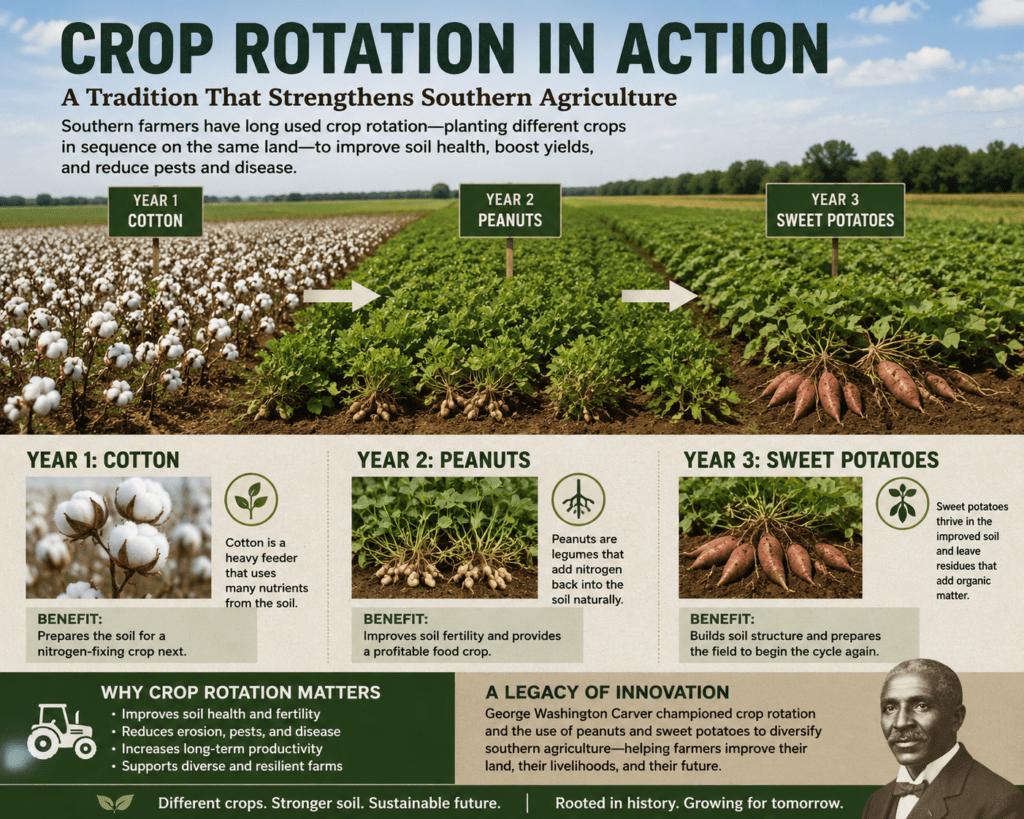
He strongly advocated crop rotation, a practice that involves alternating crops from season to season rather than planting the same crop repeatedly. This approach helps replenish soil nutrients, reduce pest pressures, and improve overall soil health.
Carver also encouraged the use of natural fertilization techniques to restore fertility to exhausted farmland. These recommendations helped farmers increase yields while maintaining healthier soils for future generations.
Saving Southern Agriculture
Many historians and agricultural experts credit George Washington Carver with helping save Southern agriculture during a critical period of transition.
By encouraging crop diversification, promoting sustainable farming practices, and creating new economic opportunities for alternative crops, Carver provided farmers with practical solutions to some of their most pressing challenges.
His work not only improved agricultural productivity but also laid the foundation for more resilient farming systems throughout the South.
A Lasting Legacy
Today, George Washington Carver remains one of the most influential figures in American agricultural history. His dedication to innovation, education, and sustainable farming continues to inspire farmers, researchers, and agricultural leaders around the world.
The principles he promoted—crop diversification, soil stewardship, and scientific innovation—remain essential components of modern agriculture.
As American agriculture evolved across the Southern states, Carver’s contributions helped transform both the region’s economy and its farming practices, leaving a legacy that endures more than a century later.
Final Thoughts
When American agriculture expanded into Georgia, Alabama, Mississippi, and other Southern states, farmers faced significant challenges in finding profitable crops and maintaining soil productivity. George Washington Carver’s groundbreaking work with peanuts, sweet potatoes, crop rotation, and fertilization provided solutions that changed the future of farming in the region.
His innovations continue to serve as a reminder that agricultural success often comes from combining scientific discovery with practical solutions for farmers.