









The Rise of Cotton in Early American Agriculture
Cotton has played a pivotal role in shaping the history of American agriculture, becoming one of the nation’s most influential and economically important crops. Its journey from a wild-growing plant to a cornerstone of the U.S. economy began centuries before America became a nation.
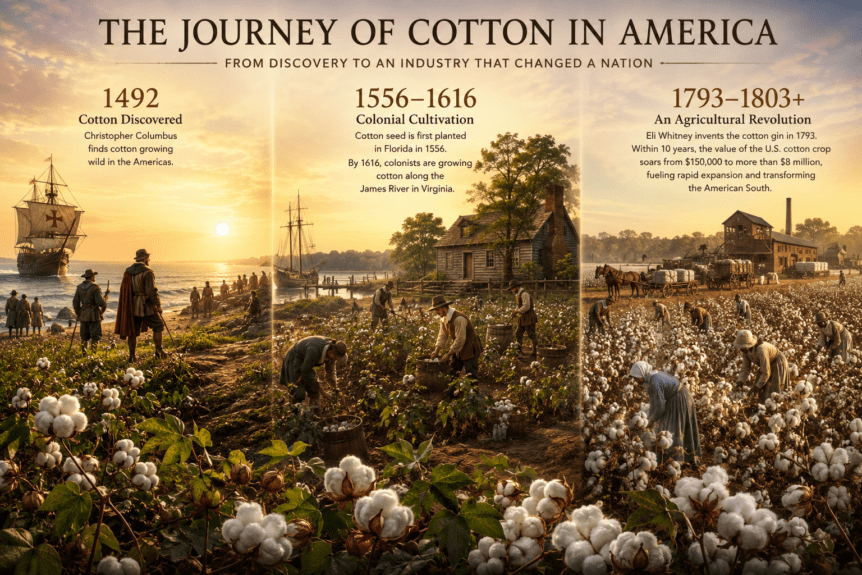
According to historical accounts, explorer Christopher Columbus encountered cotton growing wild in the Americas during his first voyage in 1492. While cotton had been cultivated in various parts of the world for thousands of years, its presence in the New World would eventually help transform agriculture across the southern United States.
Cotton Arrives in Colonial America
The first recorded planting of cotton seed in what is now the United States is believed to have occurred in Florida in 1556. Early settlers recognized the crop’s potential, and cotton cultivation gradually expanded beyond Florida’s borders.
As colonial settlements grew, so did interest in cotton production. By 1616, colonists were successfully growing cotton along the James River in Virginia. These early efforts marked the beginning of what would become a major agricultural industry throughout the American South.
Although cotton was being cultivated during this period, production remained relatively limited due to the labor-intensive process of separating cotton fibers from their seeds. This challenge prevented the crop from reaching its full economic potential for many years.
Eli Whitney’s Revolutionary Cotton Gin
A major turning point came in 1793 when inventor Eli Whitney developed the cotton gin, a machine designed to rapidly separate cotton fibers from cotton seeds.
Before Whitney’s invention, cleaning cotton by hand was an extremely slow and labor-intensive task. The cotton gin dramatically increased efficiency, allowing farmers to process significantly larger quantities of cotton in a fraction of the time.
The impact on American agriculture was immediate and profound.
A Crop That Changed the Economy
The cotton gin helped transform cotton into one of America’s most valuable agricultural commodities. Within just ten years of Whitney’s invention, the value of the U.S. cotton crop skyrocketed.
Historical records indicate that the value of American cotton production increased from approximately $150,000 to more than $8 million during that decade. This extraordinary growth demonstrated how technological innovation could reshape an entire agricultural sector.
The rapid expansion of cotton production helped establish the crop as a dominant force in the Southern economy throughout the 19th century, influencing farming practices, trade, transportation, and rural development across the region.
Cotton’s Lasting Agricultural Legacy
From its discovery growing wild in the Americas to its widespread cultivation by colonial farmers and its explosive growth following the invention of the cotton gin, cotton remains one of the most significant crops in American agricultural history.
Its story highlights the powerful combination of natural resources, agricultural expansion, and technological innovation that helped shape the development of U.S. agriculture.
As one of America’s earliest cash crops, cotton continues to occupy an important place in the nation’s farming heritage and serves as a reminder of how a single innovation can transform an entire industry.
Based on an American Agriculture History Minute by Mark Oppold.