









American agriculture has experienced several defining moments that forever changed the way food is produced. According to historians, three major agricultural revolutions dramatically increased productivity, improved efficiency, and laid the foundation for modern farming practices.
In this edition of the American Agriculture History Minute, Mark Oppold highlights these three pivotal periods that reshaped American farming—from horse-powered equipment to genetic science.
The First Agricultural Revolution: The Industrial Revolution
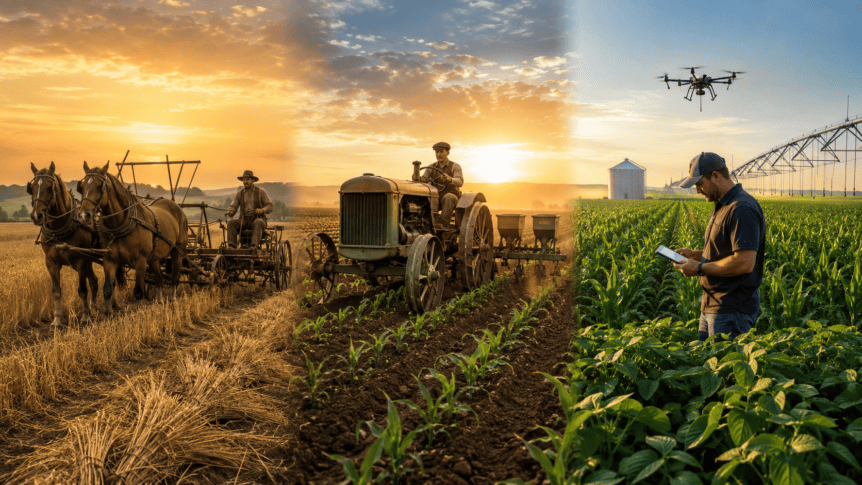
The first major transformation occurred during the Industrial Revolution in the mid-1800s. Before this period, nearly all farm work depended on manual labor. Farmers relied heavily on human strength to plant, cultivate, and harvest crops.
As technology advanced, horse-powered machinery began replacing much of that human labor. Mechanical equipment allowed farmers to cultivate larger acreages, improve efficiency, and significantly increase agricultural production.
This marked one of the earliest major technological shifts in American agriculture and helped fuel the nation’s growing food supply.
The Second Agricultural Revolution: Engines and Hybrid Corn
The second revolution arrived around World War I, when agriculture experienced another dramatic leap forward.
This era saw gasoline-powered engines replace horse power, allowing tractors and other mechanized equipment to perform tasks more quickly and efficiently than ever before. The transition from animal power to internal combustion engines revolutionized nearly every aspect of farming.
At approximately the same time, agricultural innovator Henry Wallace introduced hybrid seed corn, a breakthrough that significantly improved crop yields and consistency. Hybrid corn became one of the most influential agricultural innovations of the 20th century, helping farmers produce more grain from every acre while improving crop reliability.
Together, mechanization and improved seed genetics ushered in a new era of productivity for American agriculture.
The Third Agricultural Revolution: The Age of Genetic Science
The third agricultural revolution began during the late 1960s with remarkable advances in plant science and genetics.
Agricultural scientists developed the ability to examine and modify plant genetics, allowing them to reconfigure genetic codes that improved crop performance under challenging conditions.
These scientific breakthroughs enabled plants to better withstand:
- Excessive heat
- Limited or excessive water
- Damage from insects
These innovations have helped farmers increase yields while producing crops that are better adapted to changing environmental conditions and growing global food demands.
Continuing the Evolution of Agriculture
Each of these three agricultural revolutions built upon the one before it. From horse-powered machinery to gasoline engines, hybrid seed technology, and modern genetic research, innovation has continually transformed American farming.
Today’s producers continue to benefit from centuries of scientific advancement, allowing agriculture to become more productive, efficient, and resilient while helping feed a growing population.
As technology continues to evolve, the next revolution in agriculture may already be underway through precision agriculture, automation, artificial intelligence, and advanced biotechnology.