









How Buffalo Helped Transform the Grain Trade
The movement of grain from farms to markets has always depended on transportation and efficient handling systems. In the early 1840s, a major innovation emerged in Buffalo, New York, that would dramatically change the way grain was moved, stored and loaded onto ships.
The story of the modern grain elevator can be traced to Buffalo, a strategically located city positioned at the intersection of two important water transportation routes. One route connected the Great Lakes to the east, ultimately providing access toward New York Harbor. The other connected Buffalo with the growing transportation network of the Great Lakes and points west.
That geographic advantage helped make Buffalo an important center for the grain trade.
Joseph Dart and the Steam-Powered Grain Elevator
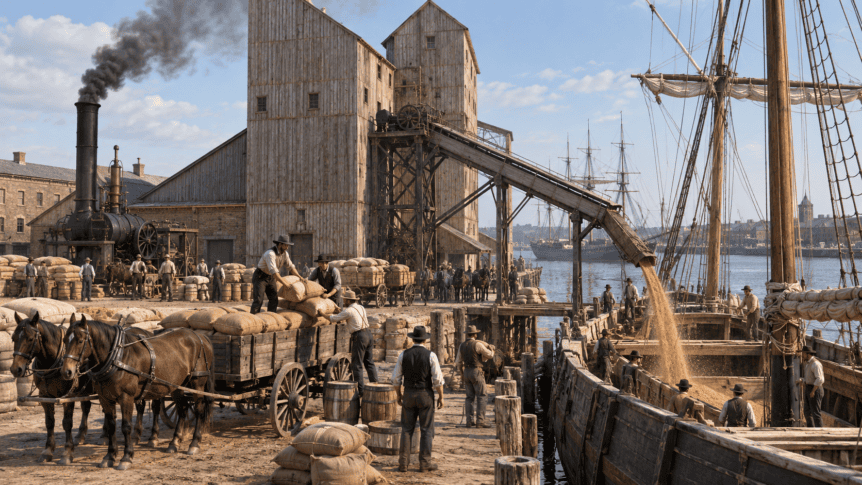
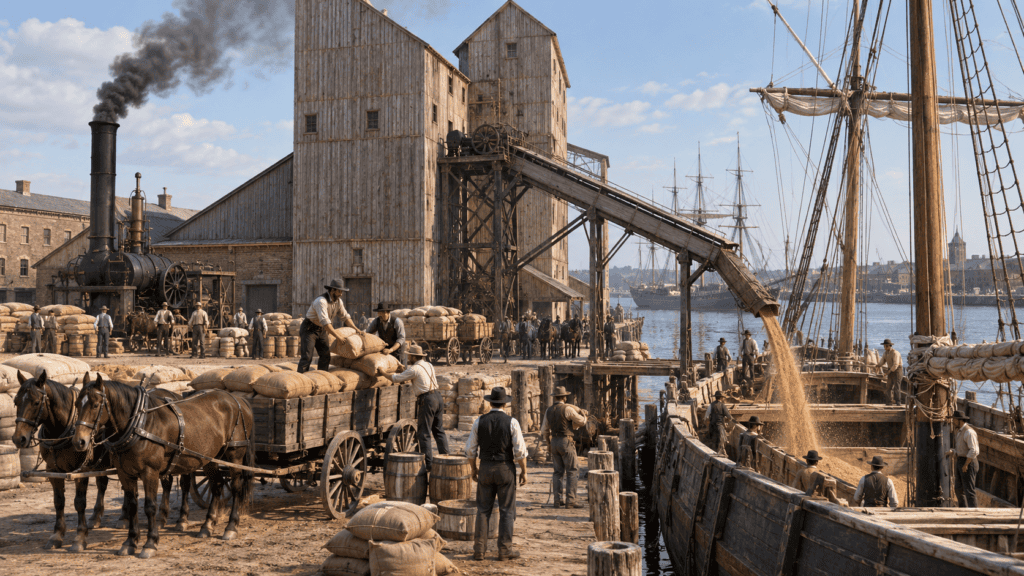
Merchant and engineer Joseph Dart is credited with developing one of the earliest successful steam-powered grain elevator and storage systems in Buffalo during the early 1840s.
Before this innovation, moving grain from storage facilities into boats was a slow and labor-intensive process. Workers had to handle grain manually, making it difficult to move large quantities efficiently.
Dart’s system introduced mechanical power to the process. A steam-powered mechanism could lift and transfer grain from storage facilities into waiting vessels much faster than human labor alone.
According to the American Agriculture History Minute, the new system could move grain to boats approximately seven times faster than humans.
The improvement was significant at a time when grain production and long-distance agricultural commerce were expanding rapidly. Faster loading meant ships could spend less time in port and could transport agricultural commodities more efficiently.
Buffalo’s Strategic Role in Agricultural Transportation
Buffalo’s location was particularly important to the development of the grain trade. The city served as a critical link between agricultural regions around the Great Lakes and eastern markets.
The water routes provided an economical way to transport large quantities of grain, while the development of mechanical grain-handling technology made those shipments increasingly efficient.
The emergence of grain elevators represented more than simply a faster way to load a boat. It helped establish a new model for handling bulk agricultural commodities—one in which grain could be stored in large quantities and mechanically transferred between transportation systems.
That concept would eventually become a defining feature of the agricultural supply chain.
Competition From Mississippi River Ports
Buffalo’s dominance in grain transportation would not last forever.
As transportation networks developed, ports along the Mississippi River increasingly competed with Buffalo for agricultural commerce. Grain and other goods could move southward through the Mississippi River system toward New Orleans, opening another major route to domestic and international markets.
The expansion of competing transportation corridors demonstrated an important reality of American agriculture: the success of farming communities depended not only on production, but also on the ability to efficiently move commodities from farms to consumers and export markets.
An Innovation That Changed Grain Handling
Joseph Dart’s grain elevator was an important step in the mechanization of agricultural transportation. By replacing much of the slow manual work involved in loading grain with steam-powered machinery, the technology increased the volume and speed at which agricultural commodities could be handled.
The basic principle behind the grain elevator—store grain in bulk and use mechanical equipment to move it efficiently—would become fundamental to the modern grain industry.
Today, massive grain elevators are familiar sights across the American agricultural landscape, particularly in regions connected to major railways and waterways. Although modern facilities use technology far more advanced than the equipment of the 1840s, the underlying goal remains remarkably similar: move large quantities of grain safely, quickly and efficiently.
The history of the grain elevator is therefore also a story about the continuing relationship between agriculture, transportation and technology.
Listen to the American Agriculture History Minute
In this edition of the American Agriculture History Minute, Mark Oppold looks back at the early development of the grain elevator and Joseph Dart’s contribution to agricultural transportation.