









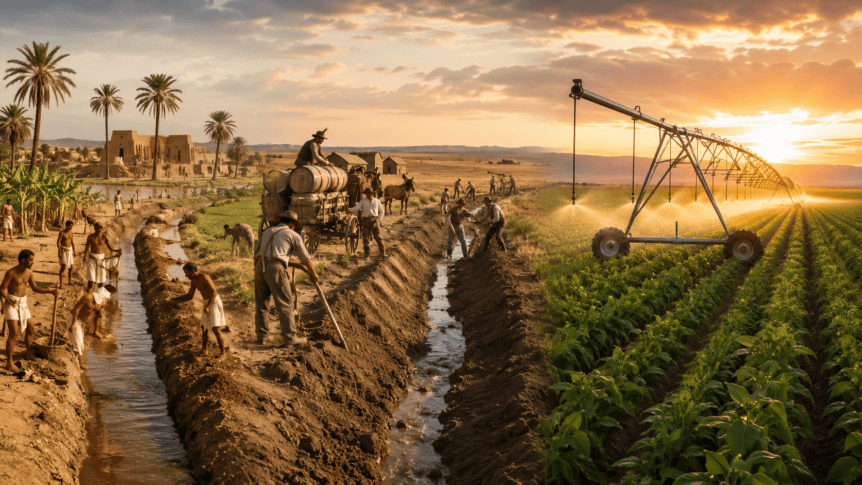
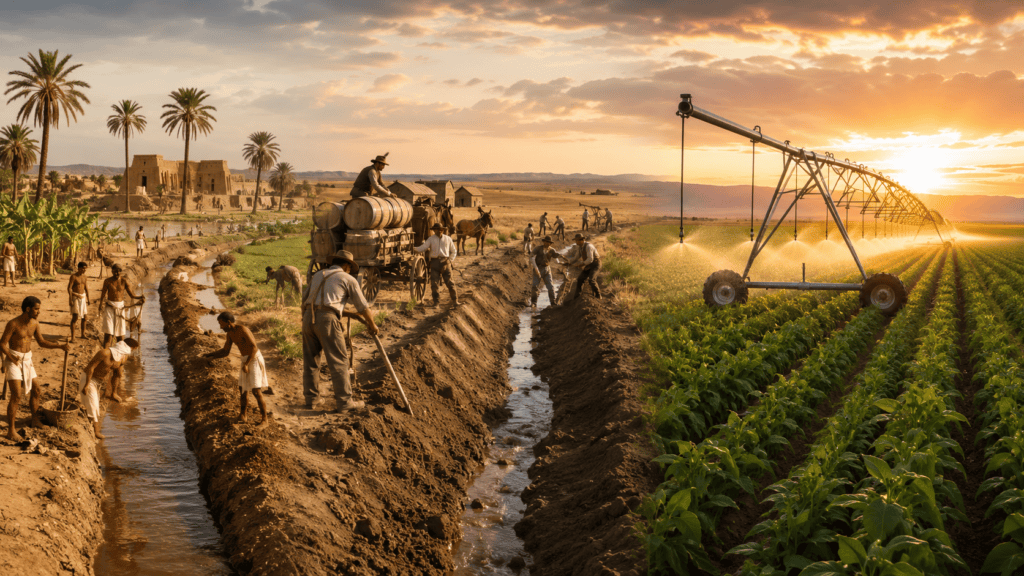
Water has always been one of agriculture’s most valuable resources, but the methods used to deliver it to crops have changed dramatically over time. From ancient civilizations to modern center pivot irrigation systems, the history of irrigation reflects farmers’ constant drive to improve crop production and adapt to challenging growing conditions.
According to Mark Oppold’s American Agriculture History Minute, the evolution of irrigation played a pivotal role in shaping agriculture across the United States.
Ancient Irrigation Began Thousands of Years Ago
The practice of irrigating farmland dates back thousands of years. Early farmers in Asia and Africa developed irrigation techniques to move water from rivers and other natural sources to their crops, allowing them to grow food in regions where rainfall alone was not sufficient.
These early innovations laid the foundation for irrigation systems that would eventually spread throughout the world.
Early American Farmers Relied on Manual Watering
In the United States, irrigation was not common during the nation’s early agricultural years.
Instead, pioneers often relied on nearby streams and rivers, manually transporting water in barrels to their fields. This labor-intensive process was necessary to prevent crops from drying out during hot weather and periods of limited rainfall.
While effective on a small scale, manually hauling water was time-consuming and impractical for larger farming operations.
Irrigation Expanded in the Great Plains
The widespread adoption of irrigation in the United States did not begin until around 1890.
Farmers in Nebraska and Colorado faced dry conditions that threatened crop production, prompting them to experiment with irrigation systems out of necessity. These early efforts demonstrated how controlled water delivery could improve crop yields and make farming more reliable in arid regions.
Their innovations helped pave the way for modern irrigation practices that continue to support American agriculture today.
Frank Zybach and the Center Pivot Revolution
One of the most significant advancements in irrigation came from Colorado farmer Frank Zybach, who is widely credited with inventing what became the Center Pivot Irrigation System in 1940.
The center pivot design transformed agricultural irrigation by allowing water to be applied efficiently across large circular fields using rotating sprinkler systems. Today, center pivot irrigation is recognized around the world and remains one of the most efficient methods for irrigating crops while helping farmers manage water resources more effectively.
A Lasting Legacy
From ancient irrigation canals to today’s sophisticated center pivot systems, irrigation has enabled farmers to produce more food while overcoming the challenges of dry climates and unpredictable weather.
The innovations developed over generations continue to play a critical role in feeding a growing global population and improving agricultural productivity.