










America’s First Toll Roads Opened New Markets for Farmers
When most people think about American agriculture history, turnpike roads probably don’t come to mind. Yet these early transportation projects played a critical role in helping farmers move their products to market and supporting the growth of the young nation’s agricultural economy.
In this edition of the American Agriculture History Minute, Mark Oppold explains how the construction of America’s first turnpikes helped overcome one of agriculture’s biggest challenges in the late 1700s—transportation.
Farmers Faced Major Transportation Obstacles
As the United States expanded following the Revolutionary War, many farmers produced more grain, livestock products, and hides than they could consume locally. However, getting those goods to larger markets was often nearly impossible.
Roads were little more than rough dirt paths that became muddy, rutted, and impassable during bad weather. Without dependable transportation routes, farmers struggled to sell their surplus crops and animal products, limiting both their income and the nation’s agricultural growth.
The First American Turnpike
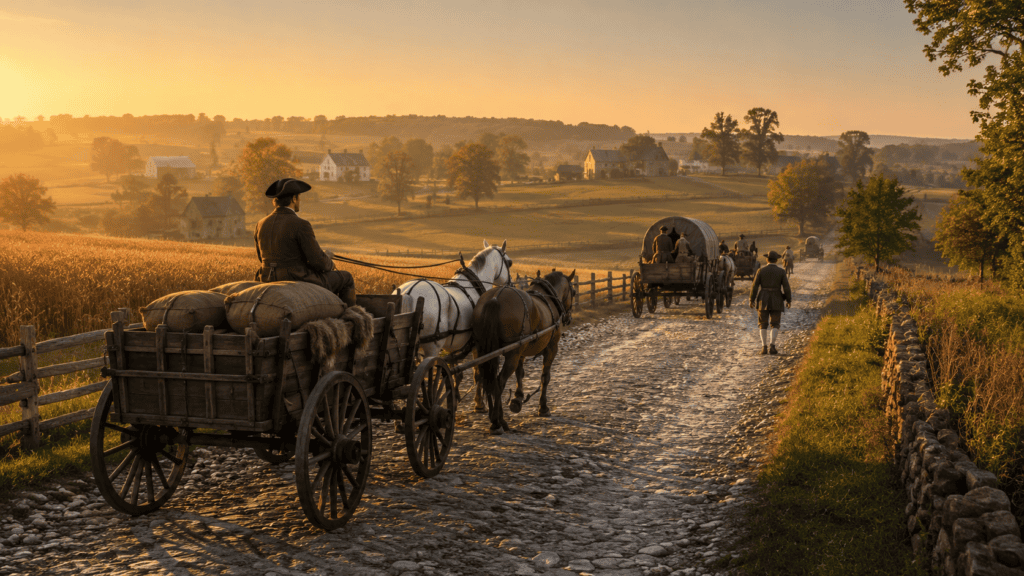
In 1794, America’s first turnpike opened between Philadelphia and Lancaster, Pennsylvania. The 62-mile roadway was constructed using crushed rock, providing a much smoother and more reliable surface than traditional dirt roads.
Unlike public roads, travelers paid a toll to use the turnpike. Those fees helped fund maintenance and future improvements, making the route one of the earliest examples of modern transportation infrastructure in the United States.
The improved roadway made it easier for farmers to haul grain, hides, and other agricultural products to larger population centers where demand was growing.
A Rapid Expansion of Turnpike Companies
The success of the first turnpike inspired additional investment across the country.
By 1800, state governments had chartered 69 turnpike companies. Just ten years later, by 1810, nearly 400 charters had been approved.
However, many of those ambitious projects never became reality. Less than half of the chartered companies successfully built toll roads, leaving many farming communities without dependable transportation. As a result, agricultural trade continued to face significant challenges in many regions despite the growing interest in road construction.
Building the Foundation for Agricultural Commerce
Although not every turnpike project succeeded, these early transportation improvements laid the groundwork for America’s future highway systems and commercial trade networks.
Reliable roads eventually allowed farmers to move products more efficiently, connect with distant markets, and contribute to the rapid expansion of American agriculture during the 19th century.
The story serves as a reminder that transportation infrastructure has long been one of the essential building blocks of a strong agricultural economy.
About American Agriculture History Minute
Mark Oppold shares fascinating stories from America’s agricultural past, highlighting the people, innovations, and historical events that helped shape modern farming and rural America.