









Settlers Build Farms Beyond the Mississippi River
As American settlers moved west across the Mississippi River, the nation continued to expand, bringing new opportunities and challenges for agriculture. In these developing communities, farming was primarily focused on providing food and basic necessities for the family and the animals that helped sustain life on the farm.
Early farmers worked to clear land and establish productive fields, gradually expanding their operations as more acreage became available. Their farms were generally diversified, with a variety of crops and livestock providing the essentials needed for daily living.
Early Farms Supplied Families and Livestock
Farm families planted crops to feed themselves and their animals. Wheat, corn and oats were among the crops grown, while livestock provided additional food and other useful resources.
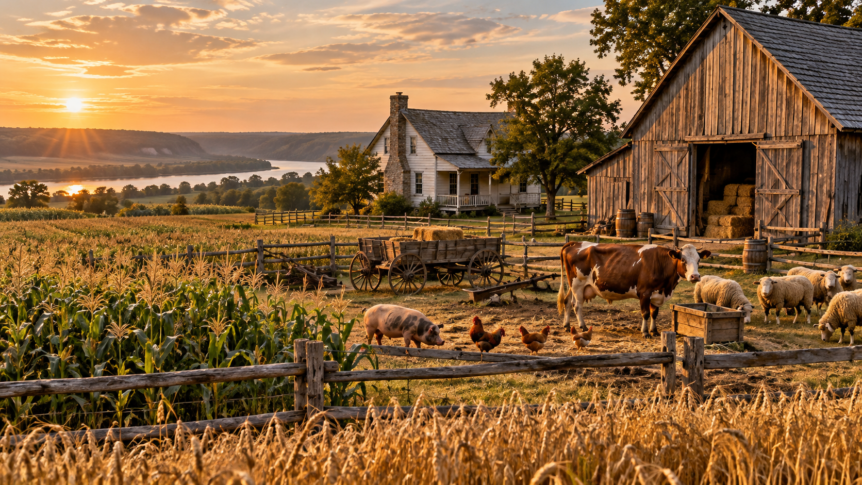
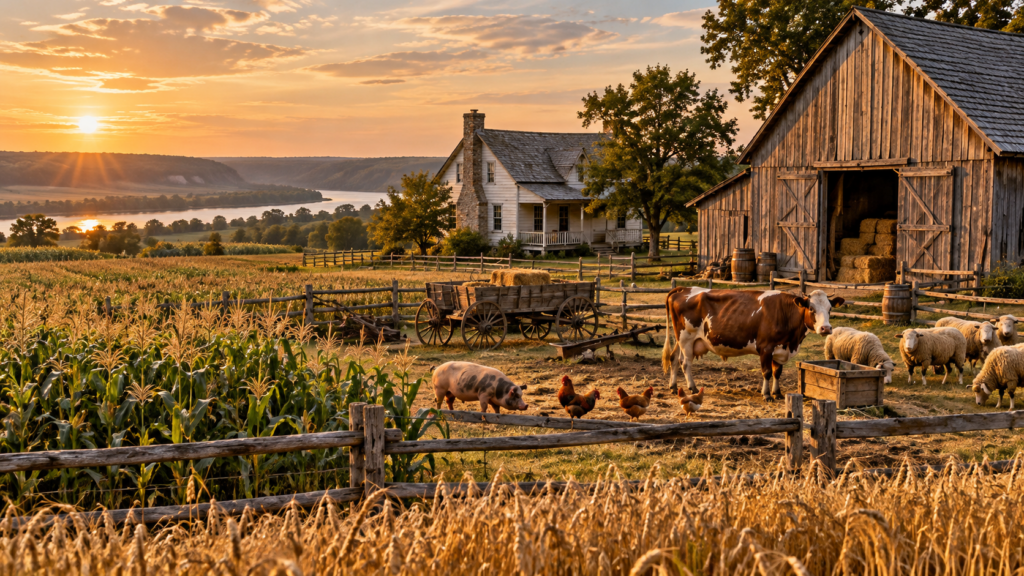
A typical farm might include a few chickens, a hog or two, a cow and perhaps some sheep. These animals helped supply the household with food and other necessities.
As families gained experience and cleared additional acreage, they could plant larger fields and increase production. What began as a small operation focused on survival could gradually become a farm capable of producing more than the household needed.
This expansion helped establish the foundation for a more commercially oriented agricultural economy, as farmers increasingly found themselves with surplus crops and livestock to trade or sell.
Bartering and Selling Farm Surpluses
When farmers produced more wheat, corn, oats or hogs than their families needed, they could trade or sell the surplus. These transactions connected farm households with merchants and other members of their growing communities.
Many of the goods farmers needed were difficult or impossible to produce themselves. Items such as sugar, coffee, thread and cotton cloth were often obtained through trade.
By exchanging their agricultural products for these goods, farm families could acquire household necessities that supplemented what they produced on their own land.
This system of bartering and selling was an important part of early rural commerce. Agricultural production did more than sustain individual families; it also helped support local economies and the exchange of goods between farms and nearby settlements.
Farm Income Helped Purchase Land and Pay Taxes
When farmers sold their surplus crops and livestock for money, the proceeds could be used to support the continued development of their farms.
One important use for that income was purchasing additional land. Expanding acreage allowed farmers to plant more crops, raise more livestock and increase their potential production.
However, farm income also came with obligations. Farmers had to pay taxes, which could take a portion of the money earned from selling their products.
For families working to establish themselves in newly settled areas, balancing household needs, farm expansion and financial obligations was an ongoing challenge.
A Foundation for American Agricultural Growth
The westward movement across the Mississippi River helped shape the development of American agriculture. As settlers cleared more land, expanded their fields and raised livestock, farms increasingly produced goods that could be exchanged or sold beyond the household.
Although early farming remained centered on family needs, surplus production created opportunities for trade, income and land acquisition. These practices helped lay the groundwork for the growth of American agriculture and the development of broader agricultural markets.
The story of these early farms illustrates how farming, commerce and westward settlement were closely connected in the nation’s development.
American Agriculture History Minute is presented by Mark Oppold.