









The Agricultural Roots of American Higher Education
The history of American agriculture is closely connected to the development of higher education, and two major milestones came in 1862: the establishment of the U.S. Department of Agriculture and the passage of the Morrill Act, which laid the foundation for America’s land-grant university system.
In this edition of the American Agriculture History Minute, Mark Oppold looks back at the events that helped create a lasting connection between agriculture, education, research and rural communities.
USDA Established in 1862
The U.S. Department of Agriculture (USDA) was established in 1862 during the administration of President Abraham Lincoln. The creation of USDA marked an important step in recognizing agriculture as a critical part of the nation’s economy and future.
USDA grew from earlier federal efforts to support American agriculture. Its responsibilities would eventually expand to include agricultural research, statistics, education, conservation, food programs and numerous services supporting farmers and rural communities.
The department’s creation came at a pivotal moment in American history, as the country was undergoing enormous economic, technological and social changes.
Congress Had Already Put Agriculture on the National Agenda
Federal attention to agriculture, however, predates USDA by several decades.
The U.S. House of Representatives created its Agriculture Committee in 1820, while the Senate established its Agriculture Committee in 1825. Those congressional developments reflected the growing importance of agriculture to the young American nation.
By the middle of the 19th century, there was increasing recognition that American farmers needed more than access to land. They also needed education, scientific knowledge and improved agricultural practices.
That need helped lead to one of the most important pieces of legislation in the history of American higher education.
The Morrill Act of 1862 Creates a New Educational Model
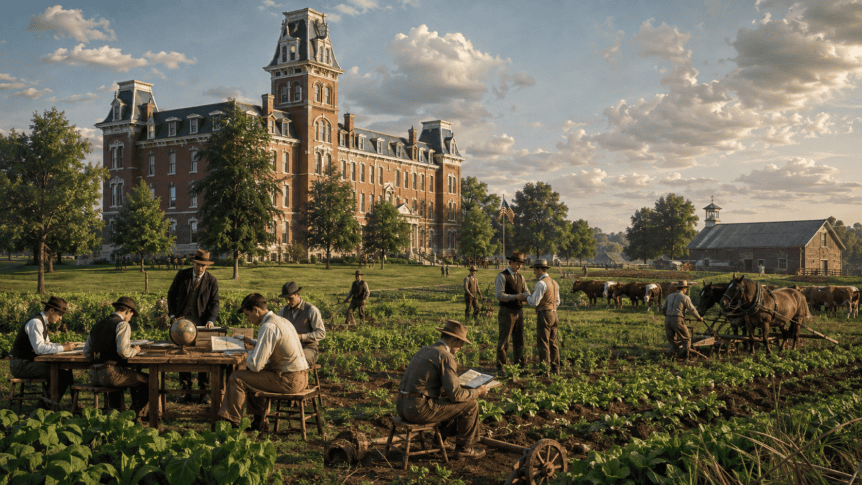
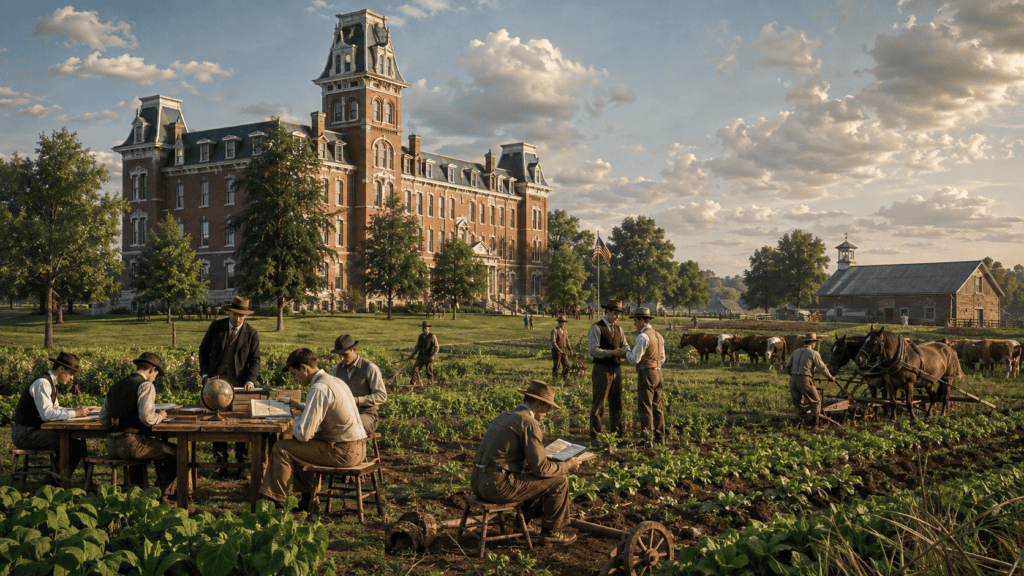
In 1862, Congress passed the Morrill Act, legislation that provided federal land to the states for the creation and support of colleges focused on agriculture and the mechanical arts.
Under the law, states received federally controlled public lands—or, in states where the lands were unavailable, land scrip that could be sold—with the proceeds used to establish and support educational institutions. The goal was to make practical higher education more accessible while preparing students for careers that could strengthen agriculture, industry and the nation’s economy.
The legislation represented a major change in the concept of higher education. Colleges were no longer intended solely for a relatively small elite. The land-grant model emphasized practical education that could benefit working Americans and their communities.
Agriculture was at the center of that mission.
Kansas State Becomes a Land-Grant Pioneer
Kansas quickly became a leader in putting the new federal legislation into action.
The Kansas State Agricultural College, now known as Kansas State University, was established in 1863 under the Morrill Act. Kansas State identifies itself as the nation’s first land-grant university created under the act.
Instruction began on September 2, 1863, with 52 students. The school was established at the former Bluemont College site in Manhattan, Kansas.
Kansas State’s early mission reflected the practical goals of the land-grant system: preparing students through education connected to agriculture and the mechanical arts.
The university would eventually grow far beyond its original agricultural mission, becoming a comprehensive research university while maintaining agriculture and agricultural research as important parts of its identity.
A Legacy That Continues Today
The land-grant system created by the Morrill Act became one of the most influential developments in American education and agriculture.
Over time, land-grant universities became centers for agricultural research, education and outreach. Their work helped farmers adopt new technologies, improve production practices and address changing agricultural challenges.
The system expanded further through later legislation, including the Hatch Act of 1887, which established agricultural experiment stations, and the Smith-Lever Act of 1914, which created the Cooperative Extension Service associated with land-grant universities.
Together, these developments established a powerful connection among universities, agricultural research and America’s farming communities.
More than 160 years later, that connection remains an important part of the American agricultural landscape.
The story of USDA and the land-grant university system demonstrates how decisions made in the 1860s helped shape the future of American agriculture for generations.
This has been the American Agriculture History Minute with Mark Oppold.