









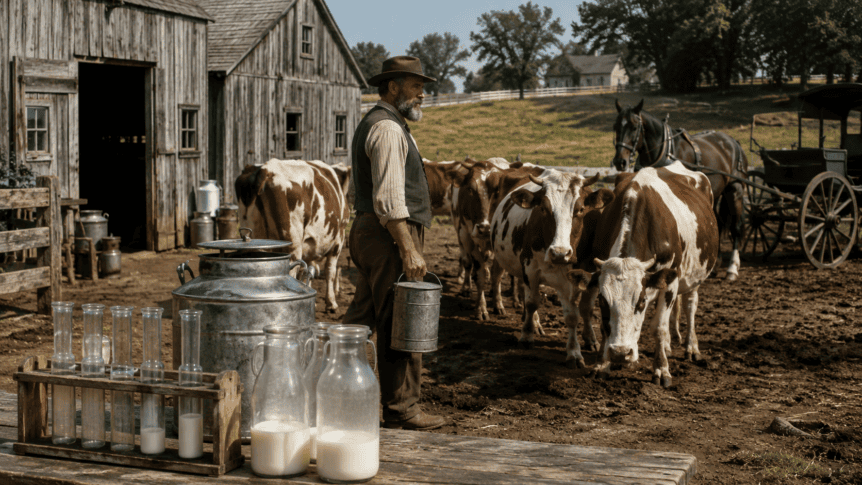
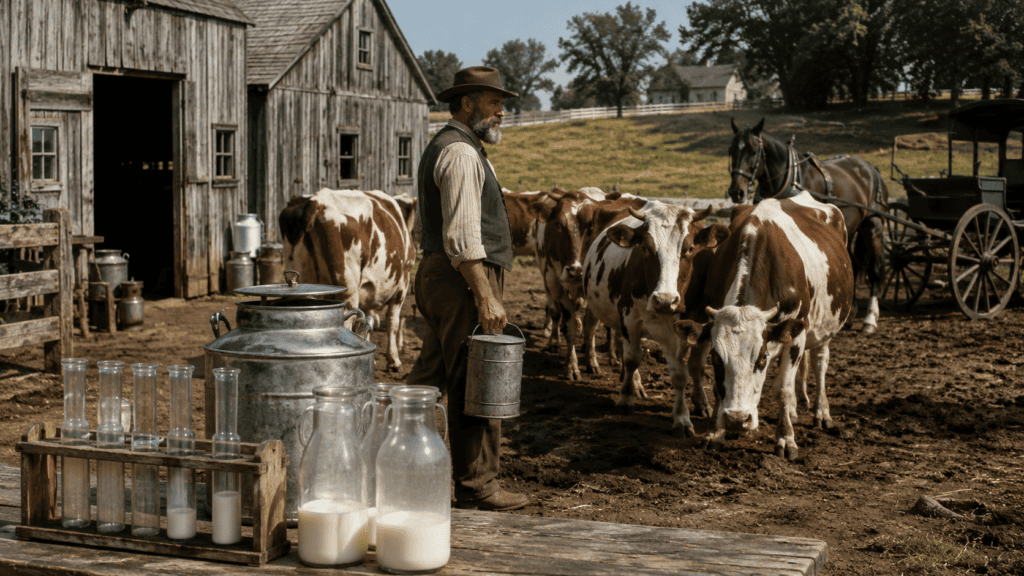
Milk production has long been an important part of American agriculture, but determining the quality and value of milk required better ways to measure its components. One scientist whose work transformed the dairy industry was Stephen Babcock, whose research ultimately led to the development of the Babcock Test for measuring milk’s butterfat content.
Born on a farm in upstate New York in 1843, Babcock developed an early connection to agriculture. Although his education took him far from the farm, his career eventually brought him back to agricultural research.
From Farm Boy to Agricultural Scientist
Babcock pursued higher education in the East before traveling to Germany, where he earned his Ph.D. His scientific training prepared him for a career that would have a lasting impact on American agriculture.
Babcock eventually joined the University of Wisconsin Experiment Station in Madison, where he focused his research on dairy cow nutrition and milk production.
His work came at a time when the growing dairy industry needed reliable scientific methods to evaluate milk. One of the most important questions was determining how much butterfat was contained in a sample of milk.
The Babcock Test
In 1890, Babcock developed what became known as the Babcock Test, a simple and practical method for determining the butterfat content of milk.
The test provided dairy farmers, processors, and researchers with a reliable way to measure the amount of butterfat in milk. This was particularly important because butterfat was a major factor in determining the value and quality of milk.
Babcock’s innovation helped bring greater consistency and scientific measurement to the dairy industry. Rather than relying on assumptions or less reliable methods, milk could be tested to determine its actual butterfat content.
The Babcock Test became one of the most significant contributions to dairy science and helped establish a foundation for more systematic milk testing and payment practices.
A Lasting Legacy at the University of Wisconsin
Stephen Babcock continued his scientific work for decades. When he died in 1931, he left his entire estate to the University of Wisconsin.
His connection to the university continues to be remembered through buildings, honors, and other recognition bearing his name.
Babcock’s story demonstrates how agricultural research can have a lasting effect far beyond the laboratory. His work provided the dairy industry with a practical tool that helped farmers and processors better understand the milk they produced and handled.
From his beginnings on a farm in upstate New York to his scientific work in Wisconsin, Stephen Babcock became an important figure in the history of American dairy agriculture.
Listen to More American Agriculture History
Stephen Babcock’s contribution is one of many important stories that shaped American agriculture. His development of the Babcock Test illustrates how scientific research and practical farming needs came together to improve an entire agricultural industry.