









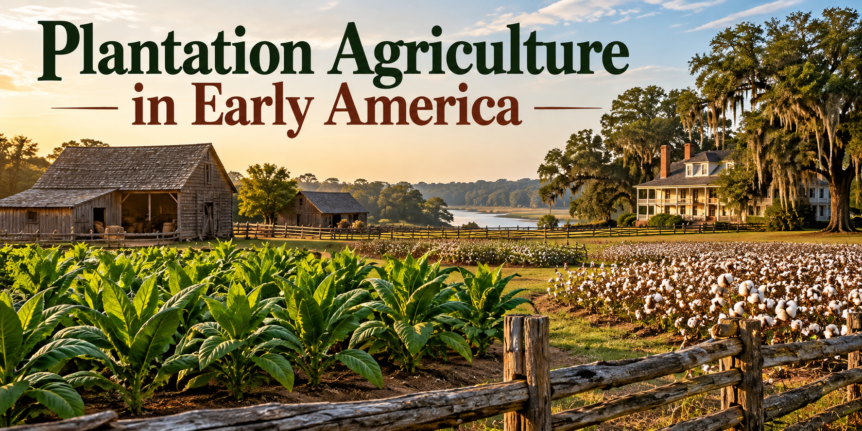
Plantation agriculture played an important role in the development of early American agriculture, beginning in the 16th and 17th centuries and expanding across the southeastern colonies as farmers cultivated crops suited to the region’s climate. Tobacco, rice, and eventually cotton became important plantation crops, while many other farms focused primarily on producing food for their families.
In this edition of the American Agriculture History Minute, Mark Oppold examines the beginnings of plantation agriculture in colonial America, its geographic expansion, and the role different crops played in the early agricultural economy.
Plantation Agriculture Begins in Virginia
Plantation agriculture began developing in the American colonies during the 16th and 17th centuries. Virginia was an early center of this agricultural system, particularly as tobacco cultivation expanded.
From Virginia, plantation agriculture spread north into Maryland, where tobacco also became a major crop. The region’s growing agricultural production helped establish tobacco as an important commodity for colonial farmers and merchants.
Plantations differed from many smaller family farms in their emphasis on producing crops for commercial markets. Tobacco and other plantation crops were cultivated not only to support local needs but also to generate income through trade.
Rice and Cotton Expand Plantation Production
As plantation agriculture developed, it spread into South Carolina and other parts of the South. Rice became another significant plantation crop, particularly in areas where environmental conditions supported its cultivation.
After 1800, cotton emerged as a major plantation crop. Cotton production expanded across a broad region stretching from North Carolina through Texas, where the climate was suitable for growing the crop.
The expansion of cotton production helped establish a large agricultural belt across the southern United States. Together, tobacco, rice, and cotton became closely associated with the region’s plantation economy.
It is also important to recognize that plantation agriculture was deeply connected to slavery. Enslaved people were forced to perform much of the labor on many tobacco, rice, and cotton plantations, enduring exploitation and brutal conditions. This history is essential to understanding how plantation production developed and generated wealth for plantation owners.
Most Farms Produced Food for Their Families
Although plantation agriculture attracted attention through the production of tobacco, rice, and cotton, most farms operated on a smaller scale and focused on meeting household needs.
Many families grew food for their own consumption, helping provide the necessities of daily life. Some farmers produced additional crops or goods that could be traded, while agricultural production could also help families meet their tax obligations.
This distinction highlights the diversity of early American agriculture. Commercial plantations concentrated on valuable crops, while many other farms relied on a combination of subsistence farming, local trade, and household production.
Together, these agricultural practices helped shape the economy and communities of colonial America.
Understanding America’s Agricultural History
The development of plantation agriculture illustrates how geography, climate, crop selection, and economic demands influenced farming across the early United States. Tobacco became established in Virginia and Maryland, rice expanded in South Carolina and other suitable areas, and cotton became increasingly important throughout the South after 1800.
At the same time, family farms continued to play a central role in producing food and supporting local economies.
These early agricultural systems left a lasting mark on American history, influencing regional economies, trade, labor systems, and the development of modern agriculture.
In this American Agriculture History Minute, Mark Oppold offers a brief look at how plantation crops and family farming helped define the nation’s early agricultural landscape.