









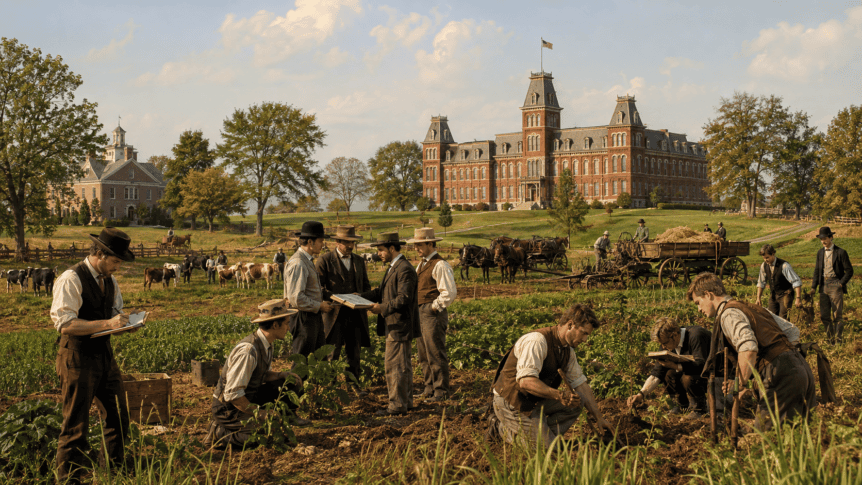
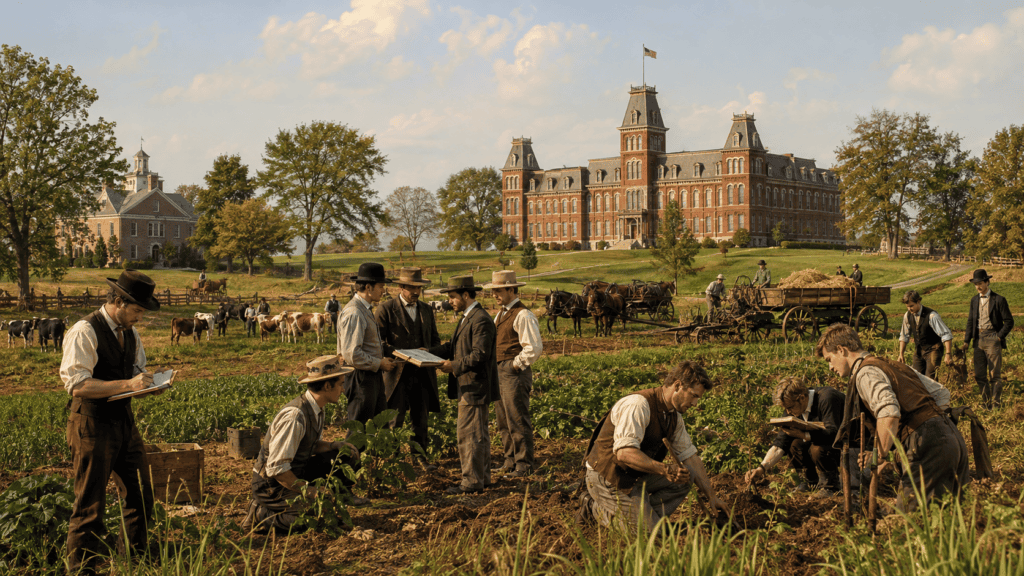
The Morrill Act of 1862 Creates a New Educational Model
The history of American agriculture is closely connected to the development of the nation’s land-grant universities. In 1862, the First Morrill Act established the foundation for a system of higher education that would dramatically expand opportunities to study agriculture and the mechanical arts.
Although many colleges and universities already existed, 1862 became a pivotal year as institutions across the country were officially designated as land-grant universities. The new designation helped expand access to agricultural education and created a lasting connection between higher education, farming, research, and the needs of rural communities.
Kansas State and Iowa State Among the Earliest
Kansas State University and Iowa State University are often regarded as the earliest institutions associated with the land-grant university system. They were followed closely by several other schools that would become major agricultural education and research institutions, including the University of Illinois, Michigan State University, The Ohio State University, and the University of Missouri.
Over time, these institutions became important centers for agricultural research, education, and outreach. Their work would help generations of farmers and agricultural professionals adopt new knowledge, technologies, and production practices.
Not Every Land-Grant University Was an Agricultural School
While agriculture was a central purpose of the land-grant system, not every institution receiving a land-grant designation was primarily an agricultural college.
The Massachusetts Institute of Technology, for example, became a land-grant institution despite its emphasis on science and technology. California Polytechnic State University, commonly known as Cal Poly, also has a land-grant connection while offering education extending well beyond traditional agricultural studies.
The land-grant model ultimately became much broader than agricultural education alone. It helped establish a national network of universities designed to make practical, career-oriented higher education more accessible while supporting economic and technological development.
A Lasting Legacy in American Agriculture
More than 160 years later, the land-grant university system remains an important part of American agriculture. Land-grant institutions continue to educate agricultural students, conduct research, develop new technologies, and provide information and resources to farmers and rural communities.
The First Morrill Act of 1862 therefore represents a major milestone in American agricultural history. What began as an effort to expand practical higher education helped create institutions that would play a lasting role in shaping American farming and the broader agricultural economy.