









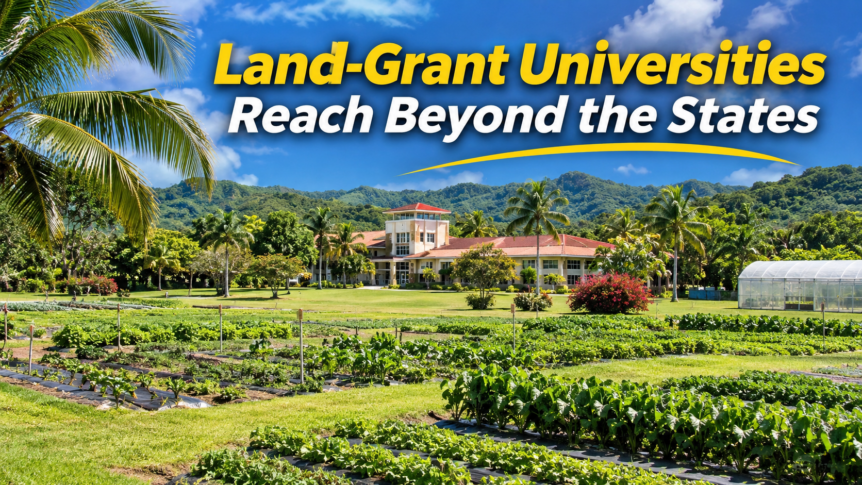
Land-grant universities are an important part of American agricultural history, helping advance agricultural research, education, and community development across the country. While many people associate the land-grant system with well-known universities in the continental United States, its reach extends much farther—including U.S. territories and island communities in the Pacific and Caribbean.
The history of these institutions highlights how the land-grant mission has expanded beyond traditional state boundaries to serve diverse communities and support agricultural education.
The Morrill Act Established the Land-Grant System
The foundation of America’s land-grant university system dates back to the Morrill Act of 1862. This landmark legislation established a framework for states to create colleges focused on agriculture, mechanical arts, and practical education.
The legislation helped make higher education more accessible while strengthening the connection between universities and the nation’s agricultural industry. Over time, land-grant institutions became important centers for agricultural research, extension services, workforce development, and education.
When people think about land-grant universities, familiar names often come to mind, including Iowa State University, Kansas State University, The Ohio State University, and Michigan State University. These institutions represent a significant part of the land-grant tradition.
However, the system’s reach is not limited to the 50 states.
Land-Grant Institutions Beyond the Continental United States
Several institutions in U.S. territories and other American-affiliated island communities are also part of the broader land-grant tradition.
Among the examples highlighted in this American Agriculture History Minute are:
- University of the Virgin Islands: Located in the U.S. Virgin Islands, with campuses on St. Croix and St. Thomas, the university carries out the land-grant mission in the Caribbean.
- University of Puerto Rico: The university system includes agricultural education and research programs that contribute to the island’s agricultural industry.
- College of Micronesia-FSM: Located in Pohnpei in the Federated States of Micronesia, the institution is part of the land-grant network serving the region.
- University of Guam: Located in the western Pacific, the university supports education, research, and community outreach through its land-grant programs.
These institutions demonstrate how the land-grant mission has developed to serve communities with different agricultural conditions, geographic challenges, and educational needs.
How the Land-Grant Mission Reached Island Communities
The expansion of the land-grant system into these regions occurred over several decades. Puerto Rico became part of the land-grant system in 1908. Later, federal legislation in 1972 extended land-grant status to institutions in the U.S. Virgin Islands, Guam, American Samoa, and Micronesia.
Unlike the original Morrill Act, which provided federal land or land scrip to support colleges, later legislation provided financial appropriations in place of land grants for these island communities.
This expansion allowed the land-grant mission to reach communities far beyond the traditional agricultural universities most Americans recognize.
A Broader Part of American Agriculture History
The land-grant university system represents more than a collection of colleges and universities. It reflects a longstanding commitment to education, agricultural advancement, research, and practical knowledge.
From major Midwestern agricultural universities to institutions in the Caribbean and Pacific, the land-grant tradition has developed to serve communities across a wide geographic area.
As Mark Oppold highlights in this American Agriculture History Minute, institutions such as the University of the Virgin Islands, University of Puerto Rico, College of Micronesia, and University of Guam are all part of this important chapter in American agriculture history.
The story of land-grant universities extends much farther than many people realize.