









From Settler Clearing to Forest Conservation
As early American settlers cleared land for homesteads, farms, and growing communities, the federal government increasingly recognized that the nation’s forests were an important natural resource that needed to be studied and managed.
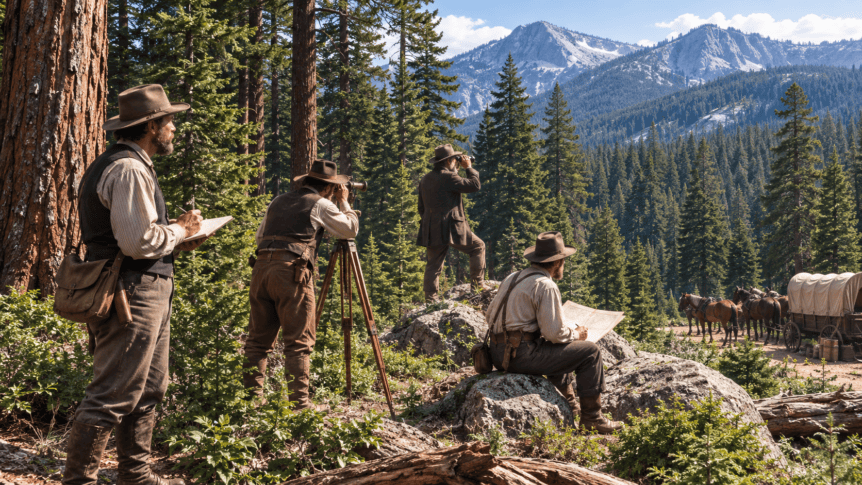
The beginnings of organized federal forest management can be traced to 1876, when Congress created an office within the U.S. Department of Agriculture to investigate and report on the quality and condition of the nation’s forests. The effort reflected a growing awareness that America’s forests were more than an unlimited source of timber. They were essential resources that required thoughtful management and conservation.
This early federal involvement marked an important step toward the development of the modern system of forest management in the United States.
The Division of Forestry Takes Shape
In 1881, federal forestry efforts expanded with the establishment of the Division of Forestry within the U.S. Department of Agriculture. The division continued the work of gathering information about forests and developing a better understanding of their condition, resources, and potential uses.
At the time, the United States was experiencing rapid population growth and westward expansion. Timber was essential for construction, fuel, transportation, and other industries, while forests also played an important role in protecting watersheds and supporting wildlife and rural communities.
The creation of a dedicated forestry division demonstrated that the federal government was beginning to approach forest resources from a broader perspective. Rather than simply viewing forests as land available for development or timber production, officials and scientists were increasingly interested in how those resources could be studied and managed for the future.
The Forest Reserve Act of 1891
A major development came a decade later. In 1891, Congress passed the Forest Reserve Act, legislation that gave the President authority to designate certain public lands in the West as forest reserves.
The law provided an important foundation for federal forest conservation. It allowed the government to set aside public lands where forest resources could be protected from unrestricted development and exploitation.
The creation of forest reserves represented a significant shift in federal land policy. It established the principle that some public lands should be preserved and managed for their long-term value rather than immediately opened for other uses.
These early steps eventually contributed to the development of the national forest system and the broader federal approach to managing America’s forests.
A Foundation for Modern Forest Management
The progression from the 1876 forestry office, to the 1881 Division of Forestry, and then to the 1891 Forest Reserve Act illustrates how the United States gradually developed a formal approach to forest conservation.
What began as an effort to assess the nation’s forests evolved into a broader federal responsibility for protecting and managing public forest lands. Those early policies helped establish a foundation for the forestry programs and conservation efforts that would follow in the decades ahead.
The story is another example of how agriculture, natural resources, and government policy have been closely connected throughout American history.
This history is presented by Mark Oppold as part of the American Agriculture History Minute.