









The First Crops of Plymouth Colony
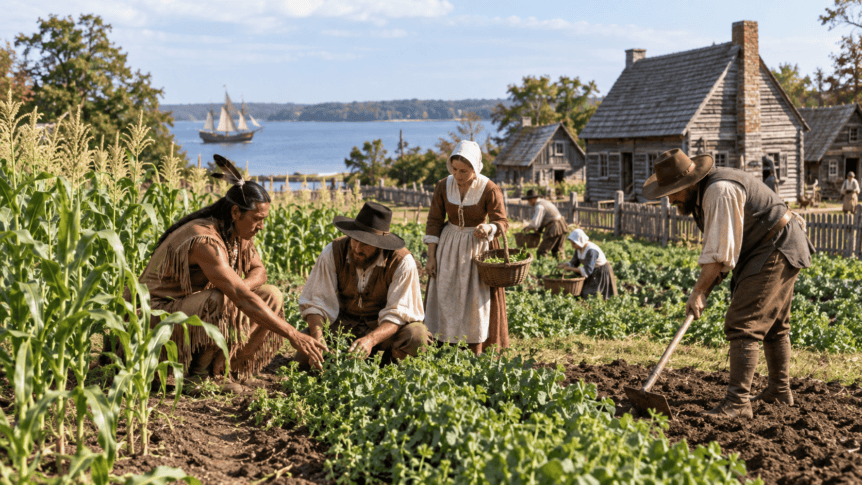
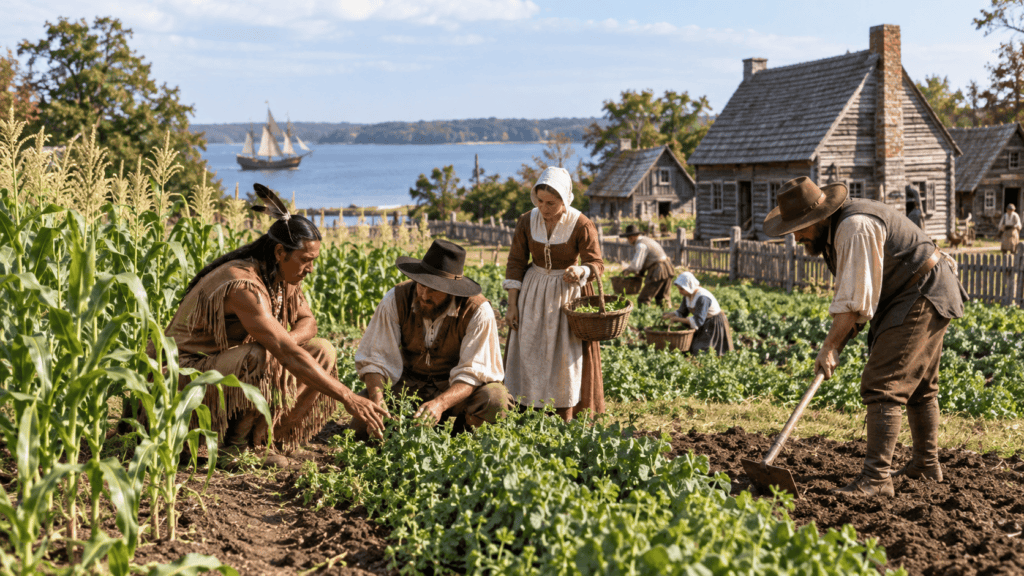
When the first settlers established Plymouth Colony, agriculture was essential to their survival. Many of the crops they initially planted had been brought with them from England, including barley and peas. These familiar crops provided an important starting point as the settlers adapted to the growing conditions and agricultural realities of their new home.
But the agricultural practices of the region would soon influence what the colonists planted and how they farmed.
Learning to Grow Indian Corn
One of the most important crops adopted by the early settlers was Indian corn, or maize. Indigenous people, including Squanto, played an important role in teaching the colonists techniques for cultivating corn and improving crop production.
Among the agricultural lessons was the use of small fish as fertilizer. Fish could be placed with the corn seed or around growing plants, providing nutrients that helped support crop growth. This practice reflected Indigenous agricultural knowledge and demonstrated how the settlers’ success depended not only on the crops they brought with them but also on knowledge gained from the people who already understood the land.
The adoption of corn would prove significant. Maize was well suited to the environment and eventually became a central part of early American agriculture and the colonial diet.
The Expansion of Colonial Agriculture
As settlements expanded and agricultural production developed, farming in the colonies began moving beyond subsistence crops. Plantation agriculture would eventually become an important part of the colonial economy, particularly in the South.
Crop production also expanded to include tobacco, which became an important commercial crop in colonies including Maryland and North Carolina. Unlike crops grown primarily to feed a household or local community, tobacco was cultivated largely because it could be sold and traded, helping establish agriculture as a foundation of colonial commerce.
This transition marked an important development in American agricultural history: farming was increasingly becoming not just a means of survival, but an economic enterprise.
From Survival to Trade
For many early settlers, agriculture was initially focused on producing enough food for themselves and their families. They generally consumed what they grew, making their farms largely oriented toward subsistence.
Over time, however, settlers recognized that agricultural production could also create opportunities for trade. Meat from animals was particularly valuable when it could not be preserved or stored for long periods. Rather than allowing resources to go to waste, settlers could trade meat and other goods for products they needed or wanted.
Among the items obtained through trade were furs and fruits, illustrating the developing network of exchange among colonial communities and the Indigenous peoples with whom they interacted.
These early exchanges helped establish a broader economic role for agriculture. What began primarily as a means of feeding a family increasingly became part of a system in which crops, livestock and other natural resources could be exchanged for valuable goods.
The Foundations of American Agriculture
The story of early American agriculture is therefore more than a history of individual crops. It is a story of adaptation, Indigenous knowledge, economic opportunity and expansion.
The settlers of Plymouth began with familiar crops such as barley and peas, but their agricultural practices evolved as they learned from Indigenous people and adapted to their new environment. Indian corn became increasingly important, while the use of fish as fertilizer demonstrated the value of Indigenous farming knowledge.
As colonial agriculture expanded, plantation production and commercial crops such as tobacco transformed farming into an increasingly important economic activity. At the same time, trade allowed settlers to turn agricultural products and livestock into resources that could be exchanged for other necessities and valuable goods.
These developments helped lay some of the foundations for the agricultural economy that would continue to evolve throughout American history.
American Agriculture History Minute
This history of America’s agricultural beginnings is presented by Mark Oppold in the American Agriculture History Minute.
From the first crops planted by settlers to the development of commercial agriculture and colonial trade, every chapter of American agricultural history offers insight into how farming helped shape the nation.