









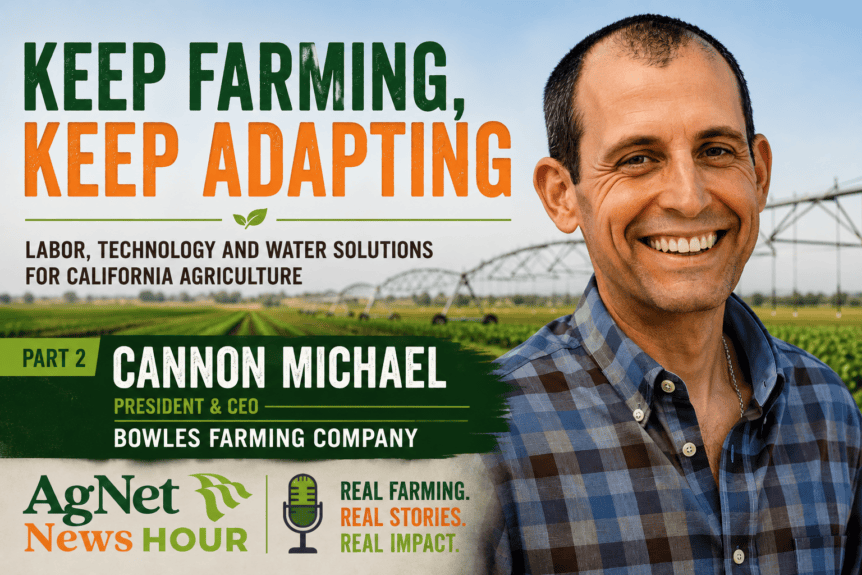
The future of California agriculture may depend on solving some problems that farmers simply cannot solve on their own. In Part 2 of his conversation on the AgNet News Hour, Cannon Michael, president and CEO of Bowles Farming Company, discusses the need for a reliable agricultural workforce, the growing role of automation and his concerns about California’s long-term water future.
Labor remains one of the biggest issues. Michael said policymakers need to recognize that agriculture depends on workers willing to perform difficult jobs that many Americans simply aren’t interested in doing. Rather than allowing the issue to continually become entangled in the larger immigration debate, he believes the country needs a reasonable legal pathway for people who want to work.
“We need to find ways that people can…have the same opportunities that many of our ancestors came to the United States for,” Michael said, while emphasizing the need to maintain border security and keep bad actors out.
Technology is helping Bowles Farming Company respond to rising costs. The operation is already using AI-enabled sprayers that identify weeds, while also incorporating AI into office operations. Michael expects autonomous tractors and other technologies to play an increasingly important role.
But technology can’t replace everyone. Experienced workers can determine by sight which watermelon is ready to harvest or carefully pick a fresh-market tomato without damaging it—skills that remain difficult to automate.
Perhaps Michael’s greatest concern is water. With projects such as Sites Reservoir and Delta conveyance taking years to move forward, he worries California agriculture could lose productive farmland before adequate infrastructure is built.
“We have to have water to do what we’re doing,” Michael said. “You can’t just get water one year and then…not have water for two years.”
Despite those challenges, Michael isn’t giving up on California agriculture. He believes farmers will continue adapting through technology and innovation, although agriculture’s footprint could become smaller if current pressures continue.
“None of us are the faint of heart,” Michael said. “We’re not giving up.”
Listen to Part 2 of the full interview with Cannon Michael on the AgNet News Hour.
Listen to previous AgNet News Hour episodes…