











California agriculture is facing mounting challenges, from rising labor costs and water limitations to pest resistance, regulatory hurdles and the loss of family farms. But agricultural technology, automation and artificial intelligence could provide new opportunities to help growers remain competitive.
Hannah Johnson, who recently joined the University of California Agriculture and Natural Resources (UC ANR) permanently, is working to connect California farmers with the innovators, researchers and technology companies developing solutions for the industry’s biggest problems.
In an interview with “The Ag Meter” Nick Papagni, Johnson discussed the California Ag Tech Alliance, the future of agricultural automation, the importance of soil health, and why growers need a stronger voice in shaping the future of California agriculture.
California Ag Tech Alliance Puts Growers First
After spending two years as a contractor developing innovation programming for UC ANR, Johnson joined the organization permanently in May following funding for the California Ag Tech Alliance through the governor’s office.
One of her primary responsibilities is building an industry advisory board representing California’s major agricultural commodities, growing regions and farming operations of different sizes.
The board meets several times throughout the year to identify the most pressing challenges facing growers and ranchers. Johnson then shares that information with state agencies, agricultural technology investors, startups and workforce development organizations.
Her goal is to ensure that agricultural innovation is driven by problems farmers are actually experiencing rather than technology companies making assumptions about what the industry needs.
Johnson also developed the Connect Program after hearing repeated complaints from growers about being overwhelmed by agricultural technology salespeople without knowing which products actually work.
The program evaluates companies, examines their financial stability, investigates their technology and contacts existing customers to assess performance and customer service. Selected companies eventually demonstrate their products during free agricultural field days.
Pest Resistance, Water and Labor Top Grower Concerns
Johnson identified approximately 50 agricultural pain points affecting California producers.
Among the biggest concerns are pests and diseases developing resistance to available crop protection products. She noted that growers also face lengthy approval processes for new pest management tools, despite efforts by the California Department of Pesticide Regulation and programs such as IR-4 to expedite certain registrations and labeling.
Soil-borne diseases and nematodes are particularly problematic for processing tomato growers. Rodents are another growing concern because they damage crops and create potential food safety and health risks.
Water infrastructure is also a major issue. Many growers are operating with aging irrigation systems but lack the financial resources to make necessary upgrades, resulting in inefficient water use and losses.
Additional challenges include permitting obstacles involving alternatives to agricultural burning, such as compost and biochar, and the high cost of orchard removal.
Labor remains a significant problem, especially finding and paying harvest workers in labor-intensive production regions such as Salinas. Johnson also sees a major shortage of specialized training opportunities for employees expected to operate increasingly sophisticated agricultural equipment.
She expects the information collected through the grower survey and advisory process to become publicly available in a report that can help guide future agricultural investments and policy decisions.
Losing Her Family Farm Inspired Johnson’s Mission
Johnson’s commitment to agriculture is personal. She grew up on an 80-acre family farm in Layton, California, where she learned the realities of farming from an early age.
In 2009, when her father became ill, she and her sister took over the family operation. Both were in their twenties when they faced serious financial challenges, including depleted wells and the need for a substantial operating loan to continue farming.
Ultimately, they made the difficult decision to sell the farm.
Johnson said it remains one of her greatest regrets. After spending several years working in philanthropy and community development, she returned to agriculture with a renewed purpose: helping prevent other farm families from experiencing the same outcome.
She understands why younger generations sometimes hesitate to take over family operations after watching their parents struggle with expenses, regulations and financial uncertainty.
However, she believes agricultural innovation and emerging opportunities could make farming more attractive to the next generation.
Automation and AI Could Change Farming
Johnson said early responses to UC ANR’s grower survey indicate that farmers are comfortable with automation investments offering approximately a 2.5-year payback period.
Growers are willing to invest, but the technology must deliver a reasonable return within a timeframe that makes financial sense.
She also emphasized that successful agricultural technology companies provide substantial support after the sale. Farmers need employees who understand both agricultural production and technology to help integrate new equipment into existing operations.
Artificial intelligence could further improve agricultural decision-making. By collecting years of irrigation, weather and soil moisture data, growers may eventually be able to predict ideal harvest timing and make more precise production decisions.
However, Johnson acknowledged that some farmers still prefer physically inspecting their fields rather than relying entirely on software platforms.
She hopes technology will complement the experience and instincts of longtime farmers rather than eliminate the personal connection between growers and their land.
Johnson is also optimistic that California will authorize autonomous tractors and equipment within the next two years. She believes these technologies can reduce dangerous tasks while improving worker safety rather than simply eliminating agricultural jobs.
She encouraged technology developers to consult growers before developing expensive prototypes, emphasizing that solutions must address actual field problems.
Soil Health and Global Competitiveness
The conversation also addressed soil health and the challenges farmers face balancing production requirements with sustainable practices.
Johnson said growers care deeply about their land, employees and the food they produce. However, production contracts and buyer requirements can sometimes complicate soil management decisions.
She pointed to changing compost restrictions, with some buyers limiting applications within 60, 90 or even 120 days of harvest.
Papagni also emphasized the competitive disadvantages created by California’s labor, water, fertilizer and regulatory costs compared with agricultural producers in other countries.
Johnson believes innovation can help improve efficiency, reduce operating expenses and provide growers with the margins necessary to remain in business.
November 5 Ag Tech Field Day at Kearney
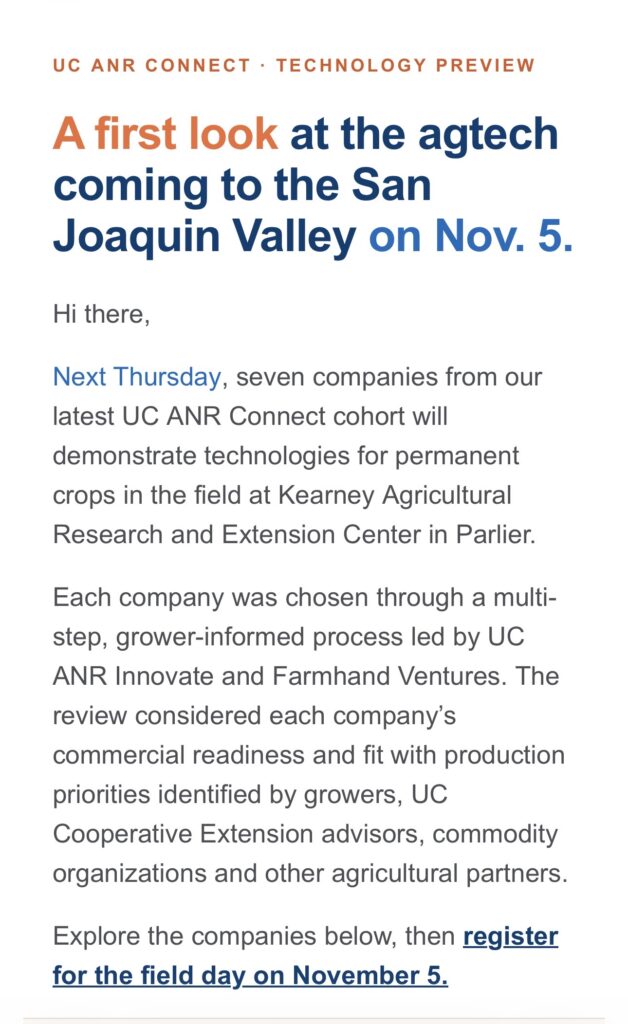
One immediate opportunity for growers to explore agricultural innovation is the UC ANR Connect Program field day scheduled for November 5 at the Kearney Research and Extension Center near Parlier.
The program focuses on permanent crops, particularly orchards and vineyards, and will feature seven agricultural technology companies demonstrating potential solutions.
Johnson explained that the selection process begins by asking growers what problems they need solved. Technology companies then submit applications, with the top 10 to 15 invited to present their products to a review group.
Approximately seven to 10 companies are selected after additional evaluations, including financial reviews and customer references.
The November 5 event will give growers an opportunity to see seven selected companies demonstrate their technologies in the field.
Johnson Wants Every Grower’s Voice Heard
Johnson encouraged California farmers and ranchers to complete the UC ANR grower survey, attend field days and connect with her through LinkedIn or email.
The information collected will help produce a report identifying agricultural challenges by commodity and geographic region, including the associated costs. The findings will be shared with state and federal agencies, investors and incoming California policymakers.
Johnson believes California agriculture has a future worth fighting for. Everybody needs to eat, she noted, and there are people throughout the state who care about the industry’s success.
Her message to growers is to remain engaged, share their concerns and help shape the solutions agriculture needs.
Hear the Full Interview with The Ag Meter
Listen to Nick Papagni’s full conversation with Hannah Johnson to hear more about the California Ag Tech Alliance, agricultural automation, artificial intelligence, workforce development and the challenges facing California’s family farms.
The interview offers an inside look at how UC ANR is working to connect growers with practical solutions and ensure that California agriculture has a voice in the industry’s future.