









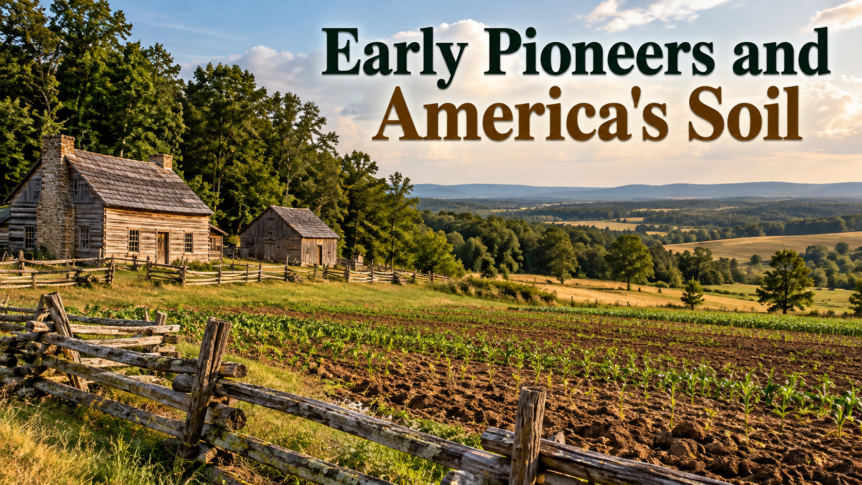
Early American farmers helped expand agriculture across the United States, but the history of westward settlement also reveals a pattern of land use that often depleted the soil rather than preserving its long-term productivity.
In this edition of American Agriculture History Minute, Mark Oppold examines how pioneers moving westward from the 1770s through the 1830s frequently relied on the natural fertility of newly settled land. When that fertility declined, many families moved farther west instead of adopting practices to maintain the productivity of the land they had already cultivated.
The historical account offers a perspective on the importance of soil stewardship and the long-term responsibility farmers have for maintaining healthy, productive farmland.
Westward Expansion Reshaped American Agriculture
From the 1770s through the 1830s, pioneers moved into new territories and frontier regions stretching from Kentucky and Alabama to Texas. Many traveled in family groups, seeking opportunities to establish farms, raise livestock and build new lives on land that had not previously been cultivated by European American settlers.
These expanding settlements played a significant role in the development of American agriculture. As families established farms across new regions, they brought more land into production and helped extend the agricultural frontier westward.
However, the availability of fertile land did not always translate into careful, long-term management. According to the historical account presented by Oppold, many first-generation pioneers did not cultivate the land in ways that protected its productivity over time.
When Natural Soil Fertility Was Exhausted
Newly cultivated land could initially support agricultural production through its existing supply of nutrients and organic matter. But repeated cultivation without adequate practices to replenish soil fertility could gradually reduce the land’s ability to sustain crops.
Oppold highlights a pattern described by historians: rather than properly cultivating and maintaining the soil, some early pioneers used the natural fertility of newly settled land until its productivity declined.
When the land no longer produced as well as it once had, these farmers often chose to sell their holdings and move farther west. There, they could begin again on land with abundant natural fertility, repeating the same cycle.
This pattern meant that the agricultural frontier continued to expand while previously cultivated land could be left with declining productivity. It also illustrates how access to additional land sometimes provided an alternative to investing in long-term soil management.
Lessons From Early American Soil Management
The experience of these early pioneers challenges the assumption that farmers in every era consistently practiced careful soil conservation. Although modern farmers and ranchers often emphasize their role as stewards of the land, agricultural history shows that soil management practices have changed considerably over time.
The story also underscores a fundamental principle of agriculture: soil fertility is a resource that must be maintained if farmland is to remain productive for generations. Natural fertility can support early crop production, but sustaining that productivity requires attention to soil health and responsible land management.
Today, fertilizer management and agronomic advice are among the tools farmers use to support crop nutrition and maintain productive soils. Understanding earlier approaches to farming helps put the development of modern agricultural practices into historical perspective.
Remembering America’s Agricultural History
The westward movement of pioneers helped shape the nation’s agricultural landscape, but it also demonstrated the consequences of relying on natural soil fertility without adequately maintaining it.
As Mark Oppold explains in this American Agriculture History Minute, some early settlers responded to declining soil productivity by moving on to new land rather than restoring the fertility of existing farmland. Their experience provides a historical reminder that productive agriculture depends not only on access to land, but also on how that land is managed.
American Agriculture History Minute is presented by Mark Oppold.