









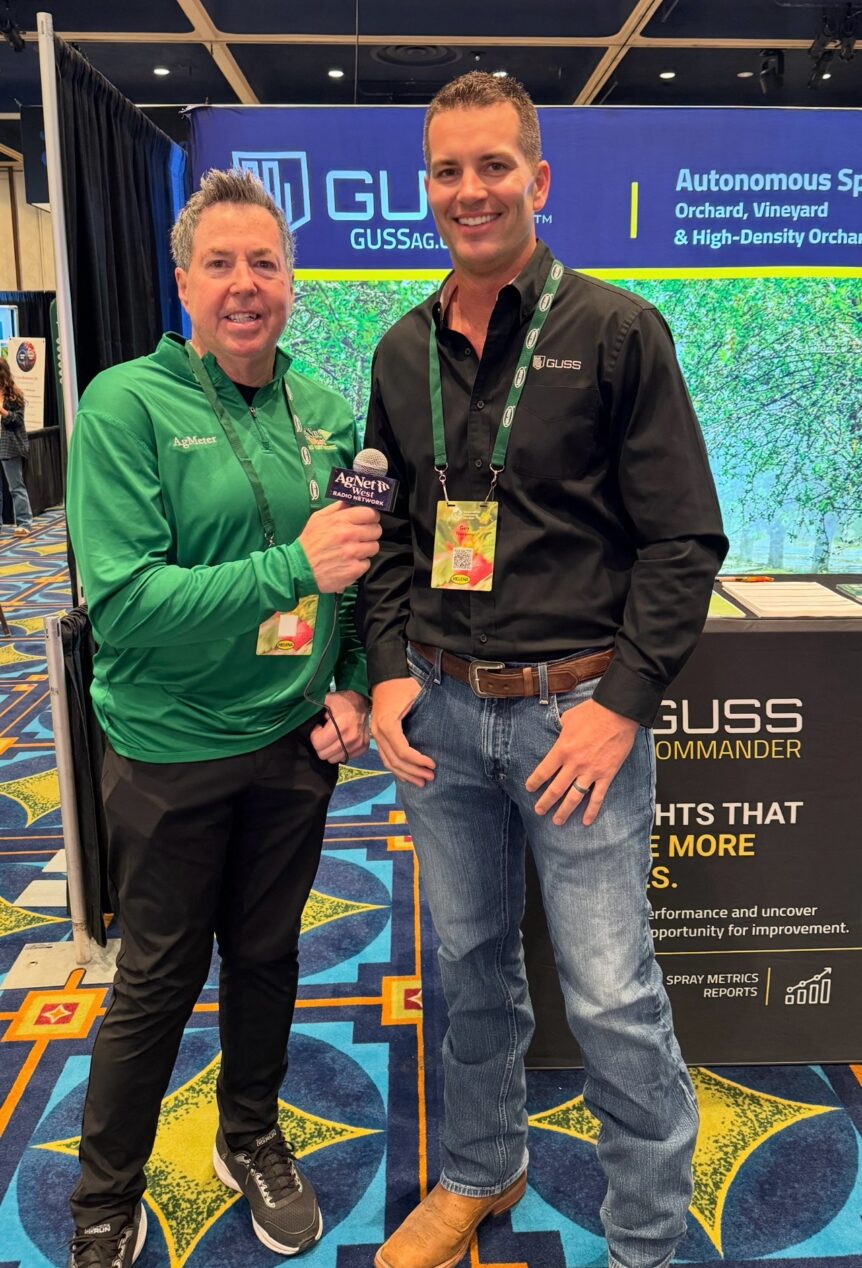
GUSS co-founder Gary Thompson discusses improved automation, new performance reporting tools, and how autonomous sprayers are helping California growers address labor challenges.

Autonomous agricultural technology continues to evolve as growers look for ways to improve efficiency, manage labor shortages, and maximize productivity. For GUSS Automation, a company founded in Kingsburg, California, the focus is on making autonomous spraying easier to operate while helping farmers cover more acres with fewer interruptions.
In an interview with “The Ag Meter”, host Nick Papagni spoke with GUSS co-founder Gary Thompson about the company’s latest technological improvements, a redesigned operator interface, advanced performance tracking, and the growing role of autonomous machinery in California agriculture.
Thompson said GUSS has made significant progress in improving machine navigation and reducing the amount of operator intervention required in the field. With more than 3 million acres sprayed autonomously, the company sees substantial opportunities for growers to improve their operations through automation.
GUSS Improves Autonomous Sprayer Performance
Thompson said GUSS has continued to refine its autonomous driving technology, making machines operate more smoothly and consistently throughout the spraying process.
A major focus has been reducing interventions per acre, allowing the machines to navigate fields with fewer interruptions. Improvements include reducing unnecessary stops triggered by the obstacle-detection system and helping the machines move through orchards more reliably.
These changes are designed to reduce the workload for the GUSS supervisor, the person responsible for monitoring and managing the autonomous equipment in the field.
Rather than constantly addressing interruptions, supervisors can spend more time overseeing operations and ensuring the fleet performs as expected.
Thompson said the objective is straightforward: make the machines increasingly capable of completing their work independently while reducing the challenges growers and their employees encounter during spraying operations.
Redesigned Software Makes Fleet Management Easier
One of GUSS’s most significant recent developments is a completely redesigned user interface, the software program supervisors use to operate the machines.
Thompson explained that a single supervisor can manage as many as eight autonomous sprayers simultaneously. With that responsibility, the software must be intuitive, efficient, and capable of providing a clear picture of what each machine is doing.
The updated interface includes fewer button clicks, simpler field mapping, easier route building, and a more streamlined appearance.
These improvements are intended to make it easier for supervisors to coordinate multiple machines during a spraying shift, particularly when operations take place overnight.
Thompson said the company recognized early in its development that ease of operation would be essential to its success. The goal was never simply to build an autonomous machine, but to create a system that farm employees could operate efficiently without unnecessary complexity.
As GUSS continues to refine its software, the company is working to make fleet management more accessible and productive for growers.
New Performance Reports Help Growers Identify Inefficiencies
Another major improvement is GUSS’s performance metrics system, which tracks spraying activity and generates detailed reports at the end of each operation.
The reports go beyond conventional spray records. They document the portion of the field covered, machine speed, material flow rate, and pump pressure. They also provide a detailed account of what each machine was doing throughout the shift.
The system records whether a machine was actively spraying, stopped for a refill, idling because a supervisor paused it, or waiting after detecting an obstacle.
This information gives growers a clearer understanding of how their equipment and crews are performing.
For example, air-blast spraying operations can lose considerable time during the process of preparing spray mixtures and refilling machines. Known as the nursing process, this work can become a significant bottleneck when multiple machines need to be supplied throughout a shift.
GUSS’s reports show average refill times, the number of refills completed, and other details that can help growers identify opportunities to improve efficiency.
With this information, farm managers can evaluate whether machines are being refilled efficiently, whether unnecessary idle time is occurring, and whether equipment is spending too much time being transported between locations.
Growers can also examine how machines are positioned at the beginning of a shift to determine whether a better setup could reduce travel and improve productivity.
According to Thompson, these performance metrics help farmers make informed decisions about their operations rather than relying on estimates or incomplete observations.
Machine Learning Helps Reduce Unnecessary Stops
GUSS is also using information gathered from obstacle detections to improve its autonomous driving system.
When machines encounter obstacles, the company uses those events to retrain its driving model. Over time, this process is intended to help the system distinguish obstacles more effectively and reduce false detections that unnecessarily stop a machine.
The result is a continuing improvement process in which real-world field experience helps refine the technology.
Fewer unnecessary stops mean more consistent operation and potentially more acres covered during each shift.
Thompson said the broader objective is to help every grower get more productivity from the equipment, with fewer interruptions and less work required from the person supervising the fleet.
Autonomous Spraying Addresses Agricultural Labor Challenges
Labor availability and rising labor costs remain significant concerns for agricultural producers, particularly for specialized tasks such as orchard spraying.
During the interview, Papagni raised the growing cost of minimum wage and asked Thompson about the importance of time and productivity for growers.
Thompson said the challenges extend beyond wages. Finding people willing to perform agricultural spraying work can be difficult, especially because conventional air-blast spraying is often conducted at night.
Traditional tractor-based spraying can also be slow, with tractors typically operating at approximately two miles per hour during these applications.
GUSS offers a different approach by allowing growers to assign trained employees to supervise a fleet of autonomous sprayers rather than requiring an individual to drive a tractor throughout the night.
Thompson described this as an opportunity to upskill existing agricultural workers and expand their capabilities.
Instead of spending an entire shift operating a single tractor, an employee can oversee several autonomous machines at once. This can give workers new technical responsibilities while allowing growers to make better use of their available workforce.
The technology is not simply about replacing a conventional machine with an automated one. It is also about changing how agricultural labor is organized so that skilled employees can accomplish more during a shift.
For growers facing labor shortages, the ability to extend the productivity of their existing teams could become an important operational advantage.
Detailed Reporting Improves Accountability
Another advantage of GUSS is the visibility it provides into overnight field operations.
Thompson noted that farm owners and managers may work during the day while their spraying crews operate at night. With conventional tractor-based spraying, it can be difficult for management to determine precisely what happened in the field during those hours.
GUSS provides a more detailed record of each operation.
Growers can establish parameters such as machine speed, material flow rate, and fan speed. The autonomous equipment then operates according to those settings while recording performance data.
At the end of the operation, the system generates a report and automatically emails it to designated recipients. Depending on the grower’s preferences, recipients can include farm management, ownership, the GUSS supervisor, and the employees responsible for preparing and supplying spray materials.
This reporting system gives everyone involved access to the same operational information, helping farm teams evaluate performance and identify areas that need attention.
For growers managing multiple machines across large orchard operations, that visibility can be particularly valuable.
More Than 3 Million Acres Sprayed Autonomously
Although GUSS has been developing its technology for approximately 12 years, Thompson said the company believes autonomous agriculture is still in the early stages of its evolution.
The company has already accumulated more than 3 million acres of autonomous spraying, giving it substantial experience in commercial agricultural operations.
Thompson said growers have experienced success with the equipment, and he is encouraged by the accelerating development of autonomous technology.
He emphasized that autonomous spraying is not merely a future concept. It is already being used by agricultural producers, with continuing improvements expected to expand its capabilities and value.
For GUSS, the next phase involves building on its experience, improving machine performance, simplifying fleet management, and helping growers achieve greater productivity from each spraying shift.
How California Growers Can Learn More About GUSS
Thompson encouraged interested growers to visit GUSSAg.com to learn more about the company’s autonomous spraying equipment and available solutions.
The company also welcomes visitors to its facility in Kingsburg, California, where growers can arrange tours and demonstrations of the machines.
In addition, various John Deere dealers, particularly throughout California, sell, service, and support GUSS equipment.
As California agriculture continues to confront labor constraints, rising operating costs, and pressure to improve efficiency, autonomous spraying technology offers growers another tool for managing their operations.
Thompson’s message was that the technology is already making a difference in commercial agriculture, with plenty of room for further development.
For growers interested in how automation could change orchard management, the full interview with Gary Thompson on The Ag Meter provides additional insight into GUSS’s technology, its approach to improving farm productivity, and the future of autonomous spraying.
Listen to the full interview with GUSS co-founder Gary Thompson and Nick Papagni, “The Ag Meter”, to hear more about the company’s latest innovations and what they could mean for California agriculture.