









Immigration Brought Diverse Farming Traditions to America
The story of American agriculture was shaped by more than fertile soil and abundant land. The people who settled the nation also brought farming traditions, tools and agricultural practices from their homelands, helping create the diverse agricultural system that developed in the early United States.
In this edition of the American Agriculture History Minute, Mark Oppold examines how ethnicity influenced early American farming, particularly the practices brought to the New World by German immigrants.
European immigrants did not all farm in the same way. German farmers brought agricultural traditions that differed in some respects from those of English, Scottish and Irish farmers. Once in America, these settlers adapted the practices they had learned in Europe to a new environment that offered considerably more land and, in many areas, fertile soil.
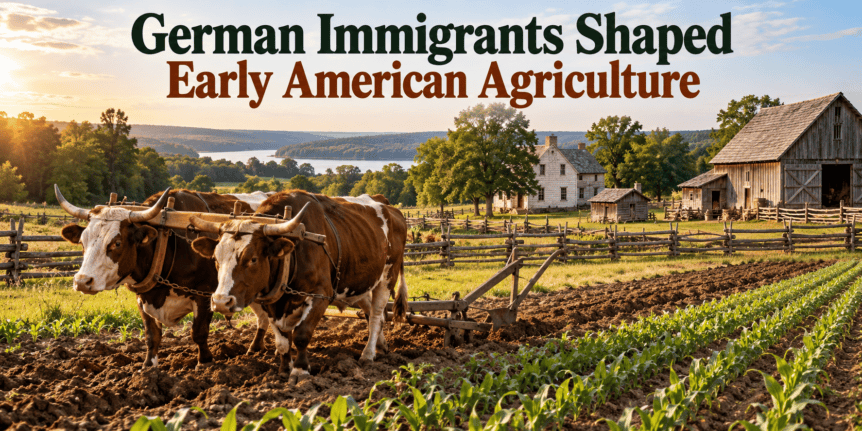
German Farmers Preferred Oxen for Plowing
One example of the differences among farming traditions was the type of draft animal used for agricultural work.
German farmers often preferred oxen over horses for plowing. Oxen provided an effective source of draft power for working the soil, particularly on farms where heavy plowing was necessary.
These choices reflected agricultural traditions that immigrants carried with them from Europe. However, once they arrived in America, those practices were applied in an environment with different opportunities and challenges.
The availability of larger amounts of land allowed immigrant farmers to expand their operations and adapt their traditional methods to American conditions.
Row Crops Were Important to German Farmers
Another distinction highlighted by Oppold was the German emphasis on row crops.
German farmers were heavily involved in producing crops in organized rows, continuing agricultural practices that had been familiar in their European homelands. The combination of traditional knowledge and America’s fertile farmland helped establish a variety of farming systems across the developing nation.
Other immigrant groups brought different agricultural priorities.
According to Oppold, Scottish and Irish farmers were also involved in crop production but were more accustomed to combining crop farming with livestock production, including raising cattle and sheep.
These differences did not mean that individual farmers followed rigid agricultural systems. Rather, they illustrate how cultural traditions and experience influenced the way immigrant communities approached farming in early America.
Immigration Helped Shape American Agriculture
The development of American agriculture was therefore influenced by a mixture of traditions. English, Scottish, Irish and German immigrants brought knowledge developed through generations of farming in Europe and adapted it to the conditions they encountered in the New World.
The availability of expansive farmland and fertile soils created opportunities for these agricultural traditions to evolve. Farmers could incorporate familiar practices while experimenting with new methods suited to their surroundings.
The differences in draft animals, crop production and livestock management are small but important examples of the broader story of American agriculture. The nation’s agricultural heritage was built by many communities, each contributing knowledge and traditions that became part of the American farming landscape.
From the animals used to prepare fields to the crops planted and livestock raised, the practices brought by immigrants helped establish the foundation for the diverse agricultural industry that would eventually develop across the United States.
Listen to the American Agriculture History Minute
Mark Oppold’s American Agriculture History Minute explores the people, inventions, traditions and events that helped shape agriculture in the United States.
I’m Mark Oppold.