









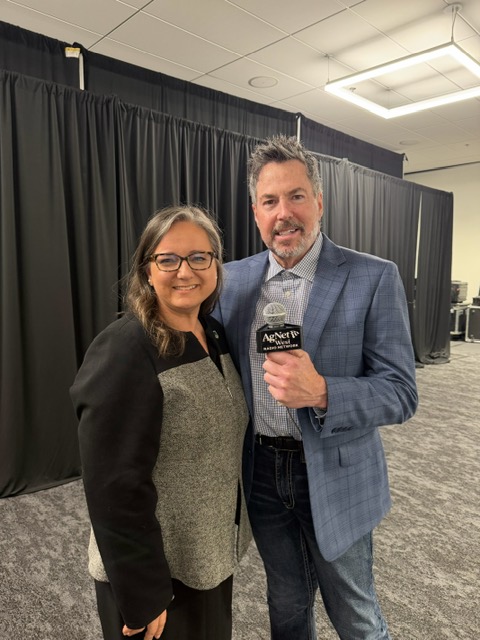
California Farm Bureau President Shannon Douglass joined “The Ag Meter” Nick Papagni for a wide-ranging AgNet News Hour interview covering some of the biggest challenges facing California farmers and ranchers, including wolves, agricultural labor, autonomous farm equipment, water infrastructure, the Farm Bill, agricultural education and the upcoming election.
Douglass, the first woman to serve as president of the California Farm Bureau, said she has enjoyed her first years leading the organization. She farms in Glenn County, where her operation includes beef cattle, walnuts and hay. Like many California producers, she said changing markets have made maintaining a diverse agricultural operation increasingly difficult.
Investing in the Next Generation
Douglass emphasized the importance of FFA, 4-H and agricultural education. With her own background in both FFA and 4-H and a Chico State education, she said California has many young people with an interest in agriculture that should be encouraged.
That effort extends to Agriculture in the Classroom and its “Taste and Teach” program, which introduces children to different fruits and vegetables. Douglass recalled her sister discovering that many students had never seen a kiwi and did not know how to eat it.
She said experiences like that demonstrate why exposing children to agriculture and fresh foods is important for building healthier communities and helping young people understand where their food comes from.
Wolves Creating Growing Problems for Ranchers
One of the biggest concerns discussed was California’s expanding wolf population. Douglass said wolf activity has moved beyond the areas initially affected and has reached additional parts of the state, including Lake and Mendocino counties.
For ranchers, the primary concern is livestock loss. Douglass said wolves are killing healthy cattle despite producers using safeguards to protect their herds. She pointed to video showing wolves moving very close to cattle while ranchers were working with their herds in Siskiyou County.
The issue is especially difficult at a time when cattle prices have provided some welcome improvement for ranchers recovering from previous difficult years. Losing livestock to wolves can erase some of that progress.
Douglass said California Farm Bureau continues working on the issue, including partnerships with UC Agriculture and Natural Resources and Resource Conservation Districts to provide training on nonlethal wolf-deterrence tools.
She also said wolf management is complicated by overlapping state and federal protections. Beyond livestock, she noted concerns about impacts on deer populations and the broader wildlife ecosystem.
Autonomous Farm Equipment Faces Regulatory Barriers
Douglass also discussed California’s restrictions on autonomous agricultural equipment. She said farmers are increasingly looking toward automation as a way to improve safety and make agricultural work more manageable, yet regulations limit their ability to use emerging technology.
She contrasted restrictions on autonomous agricultural equipment with the availability of autonomous transportation technology in California cities. Douglass said California is the only state with this particular limitation on autonomous technology in agriculture.
According to Douglass, the regulation dates back to 1978, long before modern autonomous farm equipment existed. She said the rule was not designed for today’s technology and therefore does not always fit the equipment farmers are trying to use.
Douglass compared the issue with regulations involving agricultural drones. The California Department of Pesticide Regulation has had to examine how older rules apply to newer drone technology. She gave the example of pesticide applicators being required to wear gloves, noting that operating a drone through a touchscreen can create a practical problem when the operator is wearing gloves.
California Farm Bureau and other agricultural organizations worked during the legislative session to seek changes to the autonomous-equipment rules, but the effort did not produce a fix before the session ended.
Agricultural Labor and H-2A Reform
Labor remains another major challenge. Douglass said California agriculture has very few U.S. workers applying for many seasonal farm positions, while crops often have extremely narrow harvest windows.
She emphasized that farmers need workers when crops are ready to be harvested and that the H-2A program provides an important source of seasonal agricultural labor.
Douglass explained that H-2A workers come to the United States to perform agricultural work and then return to their home countries, bringing their earnings back to their families and communities.
She said agriculture needs a faster, more efficient H-2A process while continuing to protect U.S. workers. Douglass pointed to the federal SAWA effort, or “Securing America’s Workforce,” as a potential avenue for H-2A reform.
Farm Bill Still a Work in Progress
The Farm Bill was another major topic. Douglass described the legislation as a years-long process and said agriculture was still waiting for Congress to complete the work.
She explained that the Farm Bill has traditionally combined agricultural programs with food and nutrition assistance. A significant portion has involved nutrition programs and food purchases for families and schools.
Douglass said the food-assistance component has historically helped create bipartisan support, but separating portions of the legislation has made it more difficult to find agreement.
Agriculture remains hopeful that lawmakers can ultimately reach an agreement that provides greater certainty for farmers and ranchers.
Water, Regulation and California’s Affordability Challenge
Water infrastructure and regulatory delays were also part of the discussion. Douglass said farmers need projects that can improve water reliability, while environmental and permitting requirements can make major infrastructure projects slower and more expensive.
She connected those concerns to California’s broader affordability problems, including housing and the cost of doing business. Douglass said younger Californians increasingly question whether they can afford to establish a future in the state.
She also discussed Proposition 45, which she described as an effort involving CEQA reform and streamlining environmental review. She said supporters of the measure see it as a way to establish firmer timelines and reduce delays on certain critical infrastructure projects, including water projects.
California Voters Urged to Pay Attention
Douglass urged Californians to pay attention to the entire November ballot rather than focusing exclusively on the governor’s race.
She specifically pointed to local offices, water boards and districts and the insurance commissioner race as examples of races that can have significant consequences even when they receive less public attention.
Douglass said decisions involving the insurance commissioner can affect the insurance Californians are able to access and what they pay for it.
She encouraged voters to examine the candidates and issues on their ballots and participate in every race.
Agriculture Education Remains a Priority
Douglass returned to the importance of helping children understand agriculture and the food system.
She highlighted Agriculture in the Classroom and the “Taste and Teach” program, saying exposure to fresh produce can encourage children to try healthier foods. Her story about students seeing a kiwi for the first time illustrated the disconnect that can exist between children and the food they eat.
Douglass said healthy children are important to society as a whole and that agriculture education can help build that connection.
How to Get Involved With California Farm Bureau
Douglass also invited farmers, agricultural supporters and others interested in California agriculture to become involved with the California Farm Bureau.
Contact information provided during the interview:
California Farm Bureau website: CFBF.com
Douglass said the website includes an easy “Join Now” option. She also encouraged people to contact their local county Farm Bureau, noting that Farm Bureau organizations are present in 54 California counties.
There are several ways to participate. Douglass said people interested in teaching young people about agriculture can become involved in local Ag Days and agricultural education activities. She also invited individuals interested in local agricultural decisions to consider serving on their county Farm Bureau board.
For those interested in broader advocacy, she said Farm Bureau provides opportunities to become involved all the way from local communities to Sacramento and Washington, D.C. She noted that a Farm Bureau delegation was preparing for another trip to Washington to communicate directly with federal policymakers about issues important to California agriculture.
Listen to the Full Shannon Douglass Interview
The conversation between “The Ag Meter” Nick Papagni and California Farm Bureau President Shannon Douglass cover a remarkable range of issues affecting California agriculture—from wolf attacks and livestock losses to the agricultural labor shortage, H-2A reform, autonomous equipment, water infrastructure, CEQA, the Farm Bill, agricultural education and voter participation.
For the full context and complete discussion, listen to the full interview below or on the AgNet News Hour Podcast featuring “The Ag Meter” Nick Papagni and his guest Shannon Douglass. The interview provides additional details and firsthand perspective on the challenges California farmers and ranchers are facing and the work being done to address them.