









The Agricultural Roots of Early America
Long before European colonists arrived in North America, Indigenous peoples were developing sophisticated ways to obtain food from the land. While agricultural practices varied widely among Native American cultures and regions, the history of farming in what is now the United States reaches back thousands of years.
In this edition of the American Agriculture History Minute, Mark Oppold examines the agricultural practices that existed before the arrival of European settlers and the important role Native peoples played in the early development of agriculture in North America.
It is important to recognize that there was no single form of “Native American agriculture.” Indigenous societies were extraordinarily diverse, with different environments, cultures and food systems shaping how people lived. Some groups relied heavily on hunting, fishing and gathering wild foods, while others developed settled agricultural communities.
Many Native American groups also adapted their lifestyles to seasonal food supplies. Some communities moved periodically in response to changing resources, while others established permanent or semi-permanent settlements supported by farming.
Agriculture in the American Southwest
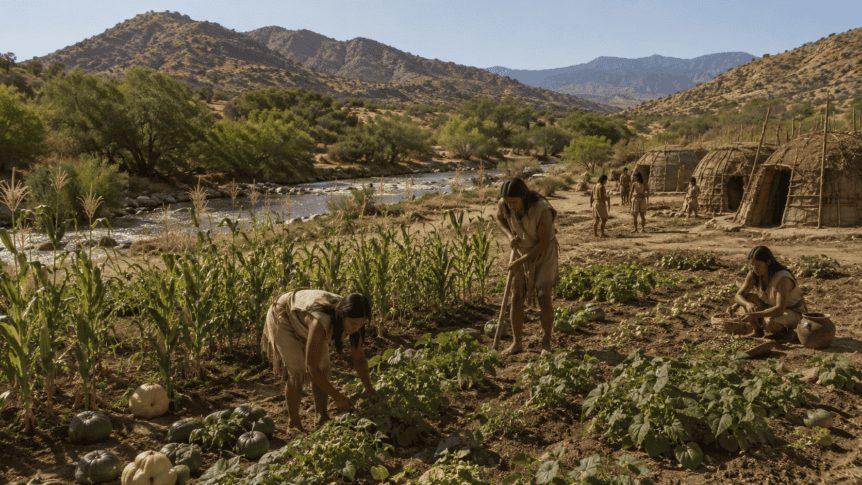
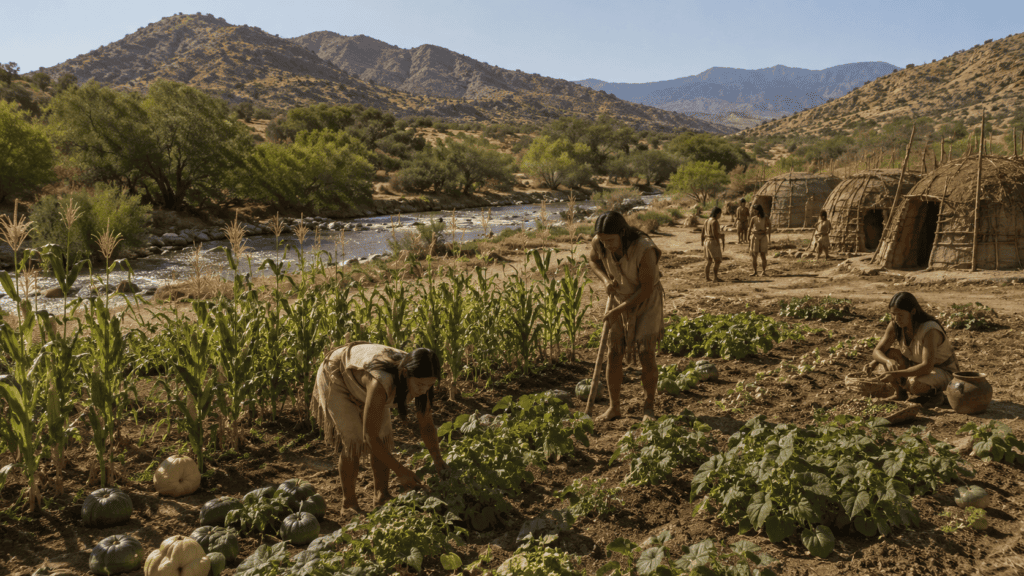
Archaeological evidence shows that agriculture in the American Southwest is far older than European settlement. Researchers have identified evidence of early farming dating to roughly 2000 B.C., with agriculture developing among Indigenous cultures in areas that include present-day Arizona and New Mexico. The National Park Service notes that the earliest dates for agriculture in the Southwest have been pushed back to approximately 2,000 B.C., with irrigation systems appearing in the region by about 1,000 B.C.
Early Southwestern farmers cultivated crops including maize, beans and squash and developed techniques suited to an arid environment. Archaeological evidence also documents water-management practices and early irrigation systems that allowed communities to produce crops despite limited rainfall.
The transcript refers to “Inca or Aztec tribes” in connection with early agriculture in Arizona and New Mexico. That description should be corrected for historical accuracy. The people practicing agriculture in the ancient Southwest were Indigenous cultures of the region, not the Inca Empire or the later Aztec Empire. Archaeological research identifies early Southwestern agricultural traditions and cultures that eventually included the Hohokam, Mogollon and Ancestral Pueblo peoples.
Farming Was Adapted to the Environment
Agriculture in the Southwest demonstrates how Indigenous farmers adapted their practices to challenging environments. Water was a critical resource, and early communities developed methods for directing and conserving it.
Archaeological research at sites in southern Arizona, for example, documents an Early Agricultural Period beginning around 2100 B.C. Researchers have found evidence of early settlements and agricultural activity in the Tucson Basin and surrounding areas.
Over time, agricultural communities became increasingly established. In some areas, irrigation canals, cultivated fields and other agricultural infrastructure supported growing populations and more permanent settlements.
These early farming traditions formed an important part of the long agricultural history of North America—one that began thousands of years before the arrival of European colonists.
Agriculture Before the European Colonists
European colonists eventually brought their own agricultural traditions, crops, livestock and farming technologies to North America. However, they entered a landscape in which Indigenous peoples already possessed extensive knowledge of plants, seasons, soils, water and local ecosystems.
The agricultural history of America therefore did not begin with European settlement. Instead, European agriculture became another chapter in a much longer story of people adapting to and cultivating the North American landscape.
Understanding those Indigenous agricultural traditions provides important perspective on the origins of American agriculture and the generations of farming knowledge that preceded the establishment of the United States.
The American Agriculture History Minute with Mark Oppold offers a look at the people, innovations and events that helped shape America’s agricultural heritage.