









America’s First Agricultural Revolution Changed Farming Forever
Between 1862 and 1875, the United States experienced what historians often describe as the first American Agricultural Revolution. This transformative period marked a significant shift in how farmers worked the land, replacing labor-intensive manual methods with more efficient horse-powered equipment. These innovations laid the foundation for the modernization of American agriculture and dramatically increased farm productivity.
One of the most important milestones during this era came in 1863 with the invention of the Hawkeye riding cultivator, a machine that forever changed the daily work of farmers.
From Hand Power to Horsepower
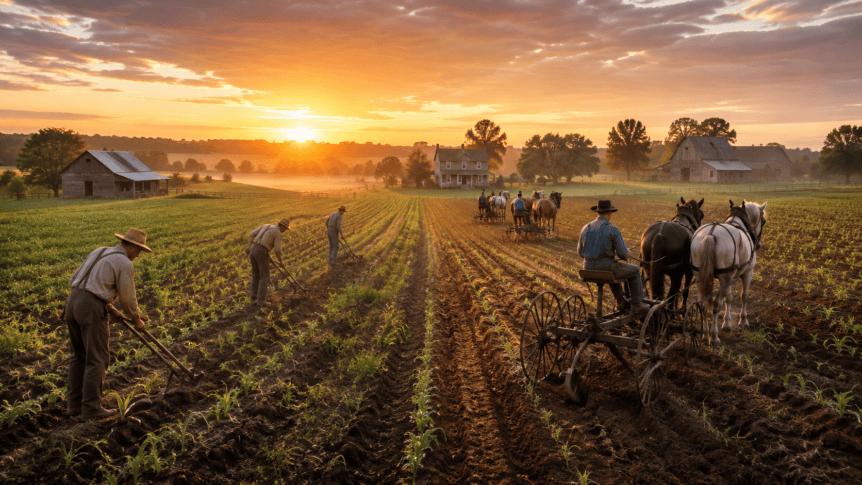
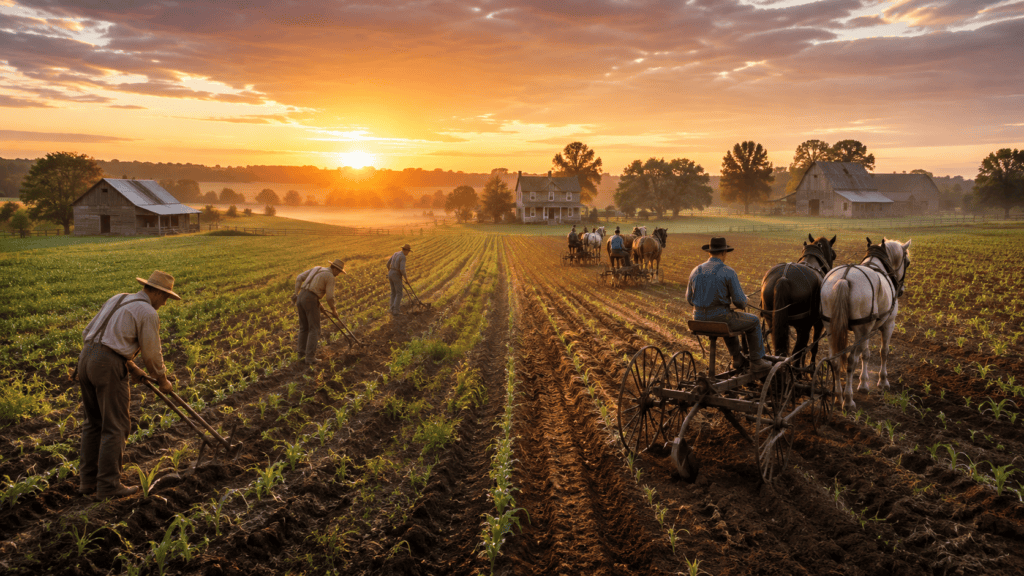
Before the Agricultural Revolution of the mid-19th century, much of America’s farming relied heavily on hand labor. Farmers spent long days walking behind implements while cultivating crops, making agriculture physically demanding and limiting the amount of land that could be worked in a single day.
As horse-powered machinery became more common, farming efficiency increased dramatically. Horses provided greater pulling power, allowing farmers to cultivate larger fields while reducing physical exhaustion.
This transition from hand power to horsepower represented one of the most significant technological advances in American agricultural history.
The Hawkeye Riding Cultivator Was a Game-Changer
Invented in 1863, the Hawkeye riding cultivator was the first agricultural implement specifically designed for the farmer to ride behind instead of walk behind.
While this may seem like a simple innovation today, it had a tremendous impact on farm operations.
By allowing farmers to sit while cultivating crops, the Hawkeye riding cultivator:
- Reduced physical fatigue.
- Increased daily productivity.
- Allowed farmers to cultivate more acres each day.
- Conserved energy that could be devoted to expanding farm operations.
The invention helped transform farming from a purely labor-intensive occupation into one increasingly supported by mechanical innovation.
A Foundation for Modern Agriculture
The introduction of riding implements such as the Hawkeye cultivator demonstrated how relatively small engineering improvements could have enormous economic and practical benefits.
Combined with other horse-powered equipment developed during the Agricultural Revolution, these advancements helped American farmers increase production, improve efficiency, and prepare agriculture for the mechanized era that would follow in the late 19th and early 20th centuries.
Today, the Hawkeye riding cultivator remains an important symbol of the ingenuity that helped shape modern American farming.