









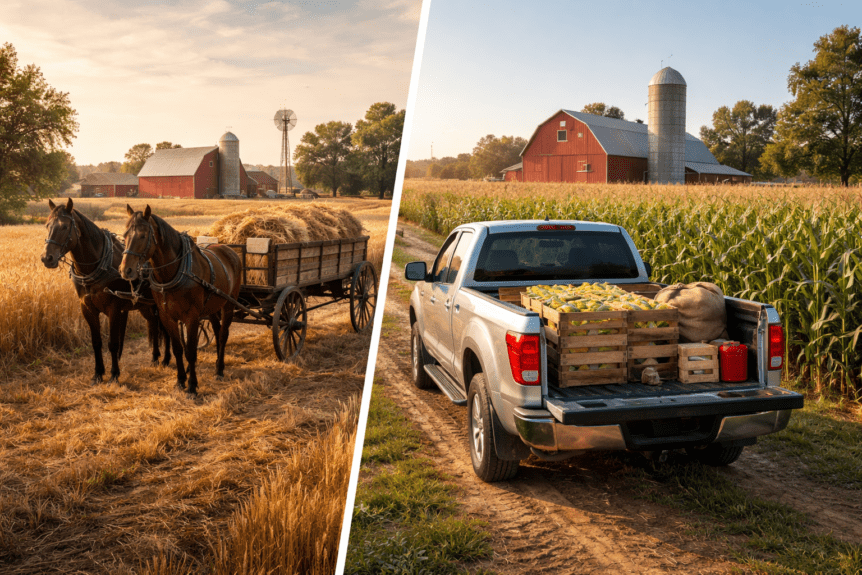
Early Transportation on the Farm
Machinery, livestock, and crops have always needed to be moved around farms or transported to market. In the earliest days of American agriculture, two-wheel carts were sufficient for settlers managing small plots of land. These simple carts allowed farmers to carry essential supplies and harvests with minimal effort.
The Rise of the Four-Wheel Wagon
As farms grew and operations expanded, two-wheel carts became inadequate. Four-wheel wagons soon became the standard, widely adopted and used across rural America for more than two centuries. These wagons could carry heavier loads, making them indispensable for transporting crops, livestock, and farm equipment.
The Advent of the Motor Truck
Pinpointing the first motor truck is difficult, but historians credit International Harvester with the first serious attempt to replace the traditional farm wagon. In 1907, the company introduced its Auto Wagon, marking a significant step toward mechanized farm transportation. This innovation set the stage for the widespread adoption of motorized trucks on farms.
Modern Farm Trucks
Since the introduction of the Auto Wagon, farm trucks of all sizes have become a staple in rural America. From small pickups to heavy-duty transport trucks, no modern farmer would consider going without a reliable vehicle. These trucks have revolutionized farm operations, making the transport of goods faster, safer, and more efficient than ever before.
Conclusion
The journey from simple carts to modern farm trucks reflects the broader evolution of American agriculture. Mechanization has consistently transformed how farmers work, and transportation innovations remain at the heart of efficient farm management. Today, the pickup truck stands as a symbol of practicality, independence, and the enduring spirit of rural America.
I’m Mark Oppold, with an American Agriculture History Minute.